





Ethereum’s liquid supply has fallen to a historic low, marking one of the most important structural developments for the asset in nearly a decade.
According to the latest data from Glassnode, only 8.7% of all ETH now remains on centralized exchanges. This is the lowest level recorded since Ethereum launched in 2015, highlighting a dramatic shift in how the asset is stored and used across the ecosystem. Analysts note that such a steep decline in available supply often becomes a defining factor once market demand begins to rise again.
ETH Exchange Balances Fall From Over 30% to Just 8.7%
The chart shows a clear, multi-year downtrend in the percentage of Ethereum held on exchanges. Exchange balances were near their peak at around 31% to 32% shortly after the 2017 bull market.
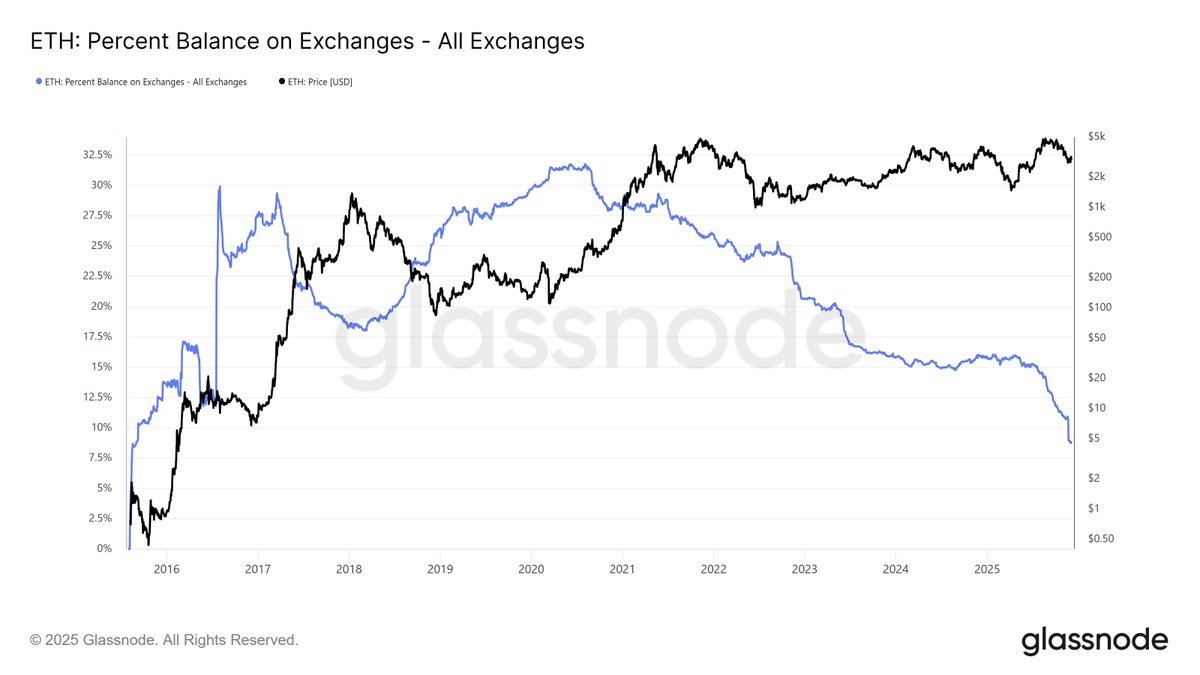
Throughout 2020 and 2021 they remained elevated, often hovering between 25% and 28%. A decisive decline began toward the end of 2021 as staking participation grew and users increasingly moved funds into DeFi protocols and self-custody. By 2024, the share of ETH sitting on exchanges had already slipped below 15%. Today, the figure has compressed even further to only 8.7%, marking the lowest point in Ethereum’s history and significantly reducing the amount of ETH that is immediately available for sale.
Why the Decline Matters for the Market
The chart pairs Ethereum’s price trend with the shrinking exchange balance, revealing a notable divergence: supply continues to be withdrawn from exchanges even during periods when price moves sideways. This tightening liquidity environment matters because it leaves order books thinner and reduces the amount of ETH traders can easily access. When demand eventually returns, a market with significantly less sell-side liquidity often reacts more aggressively. Analysts warn that this setup can amplify price swings, particularly during phases of renewed accumulation or sudden inflows.
A Long-Term Structural Shift
Glassnode’s data highlights a deep transformation in Ethereum’s supply dynamics. A growing share of ETH is being moved into long-term storage through staking contracts, locked into DeFi protocols, sent to Layer-2 networks, or simply held in private wallets.
These shifts remove tokens from the liquid supply pool and reshape the market in a way that did not exist in previous cycles. With exchange balances now at decade lows, Ethereum enters 2026 with one of the tightest supply structures in its history. If demand accelerates, the reduced availability of liquid ETH could become a powerful catalyst for stronger price reactions.



