

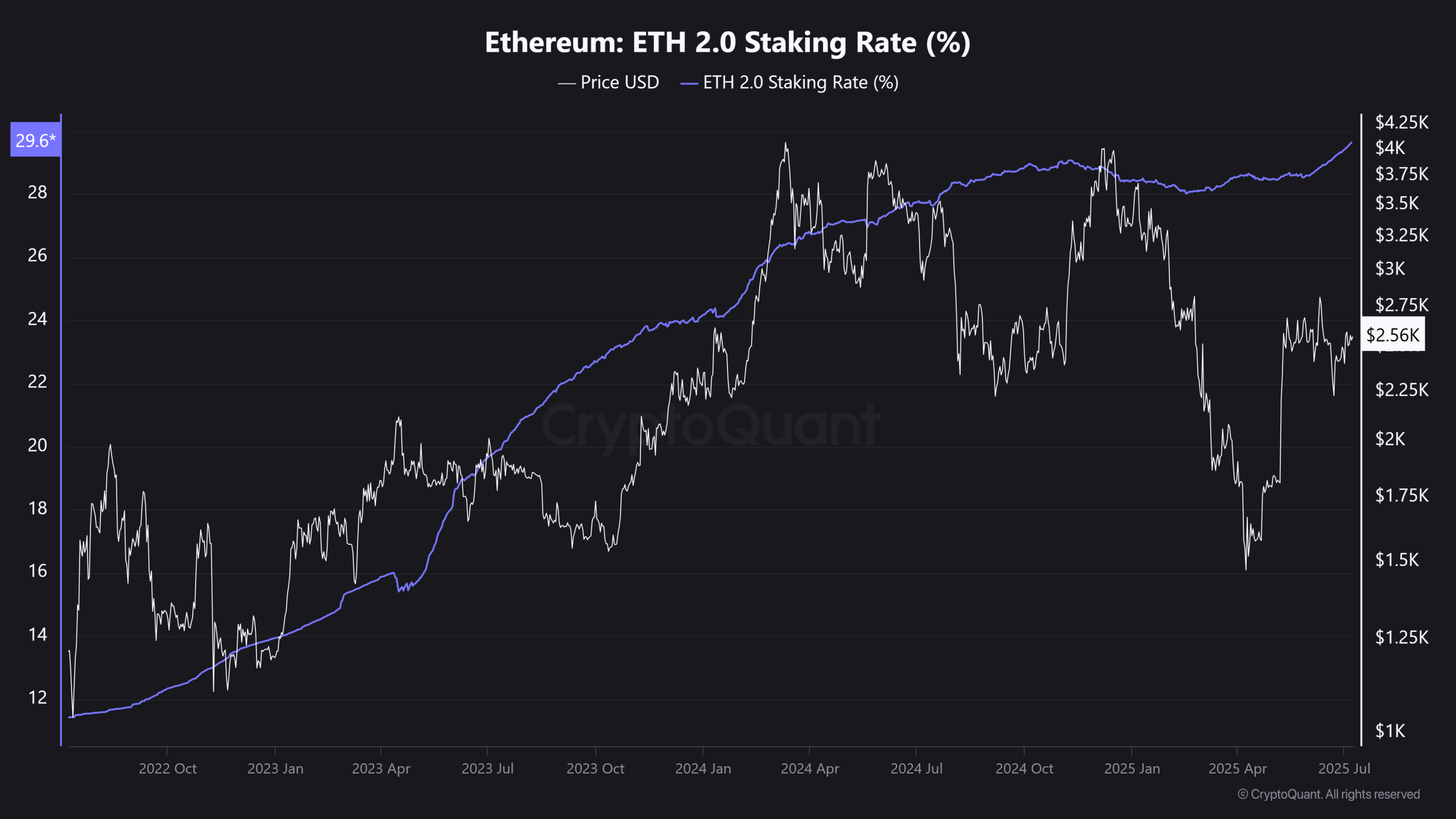
- Ethereum staking rate hits 29.6% of circulating supply, marking highest level since November 2024, according to CryptoQuant data.
- Exchange reserves of ETH decline steadily as holders withdraw assets for staking or long-term storage, reducing sell-side pressure.
CryptoQuant reports that 29.6 percent of Ethereum’s circulating supply now sits locked in staking contracts. This rate has not reached the 30 percent threshold since November 2024, according to the analytics firm’s chart.
Ethereum staking hits all-time highs (29.6%)! 🔥
At the same time, the ETH reserves on exchanges plummet to new lows (18.9M).🤯
🔸 ETH locked up 📈
🔸 Liquid ETH drying up 📉Markets haven’t priced in ETH’s shift from trade to conviction asset yet. pic.twitter.com/1zU9WrCPo7
— Leon Waidmann 🔥 (@LeonWaidmann) July 7, 2025
Leon Waidmann, an on‑chain researcher, noted that while staking climbs, exchange reserves drop.
He wrote, “Markets have yet to price ETH as a conviction asset rather than a trading token.”
However, the left‑hand graph (“ETH 2.0 Staking Rate (%)”) shows a clear link between the staking rate and ether’s value. A rising blue line often corresponds with an uptick in the white price line. The red circle marks a period when staking spiked and price gained ground.
Meanwhile, the right‑hand chart (“Exchange Reserve – All Exchanges”) reveals a steady fall in ETH held on trading platforms. A shrinking blue line indicates fewer tokens ready for sale. The red circle here also aligns with a price rise, suggesting that withdrawals may support upward momentum.
Therefore, the dual trends of higher staking and lower exchange reserves carry clear supply implications. Less ETH stays available for quick sales, and more coins earn rewards in locked contracts.
Investors now watch the staking rate and exchange balances closely. A further climb above 30 percent could tighten supply even more. Conversely, a rebound in exchange holdings may pressure prices. The coming weeks will show whether these on‑chain moves sustain ether’s advance or invite a pullback.
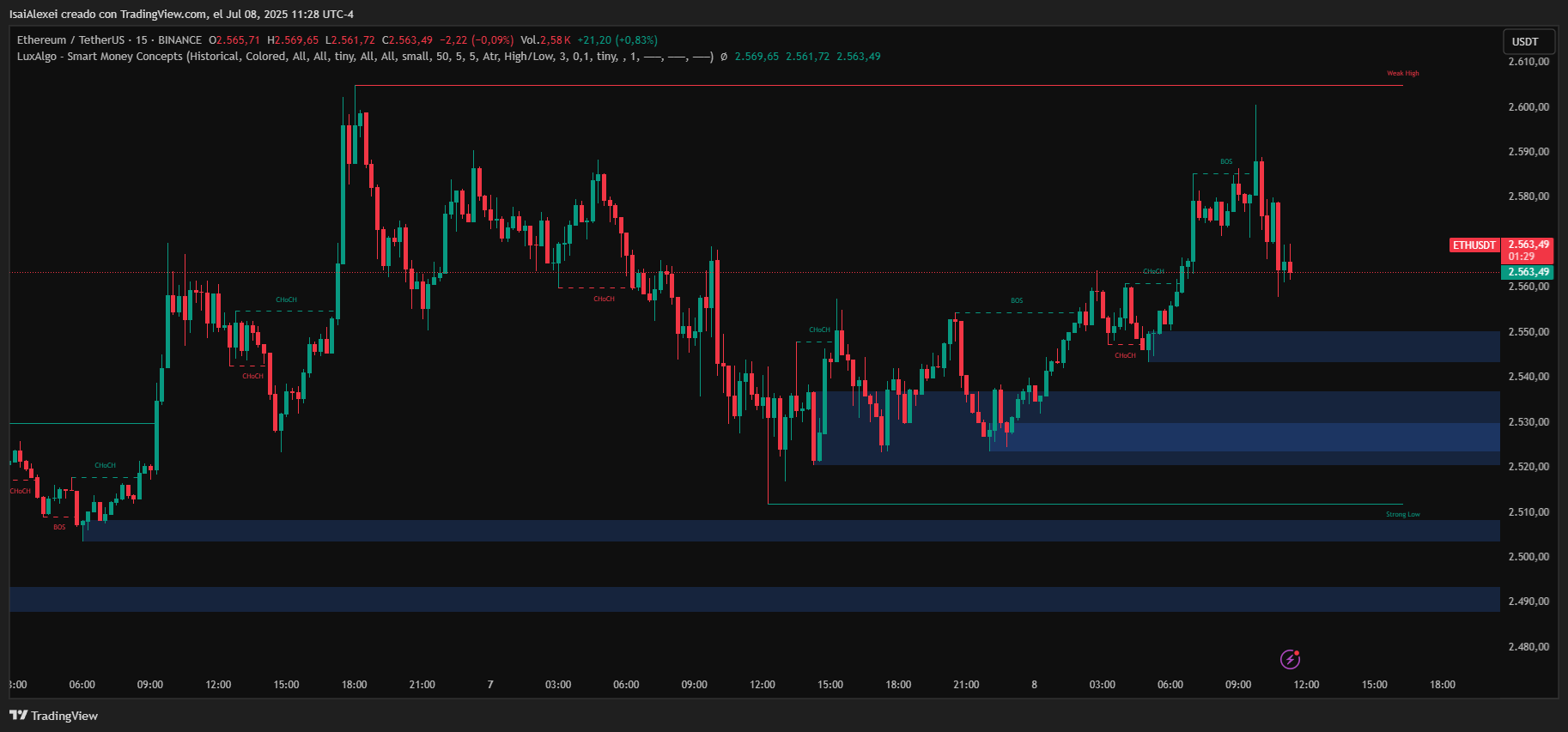
Ethereum (ETH) is trading at $2,565.19 USDT, reflecting a +1.22% daily gain and a +4.95% increase over the past 7 days. ETH maintains a market capitalization of $309.79 billion, with a 24-hour trading volume of over $14.1 billion, indicating healthy liquidity and rising investor participation. ETH currently ranks #2 globally, holding 9.05% market dominance, behind Bitcoin’s 62.9%.
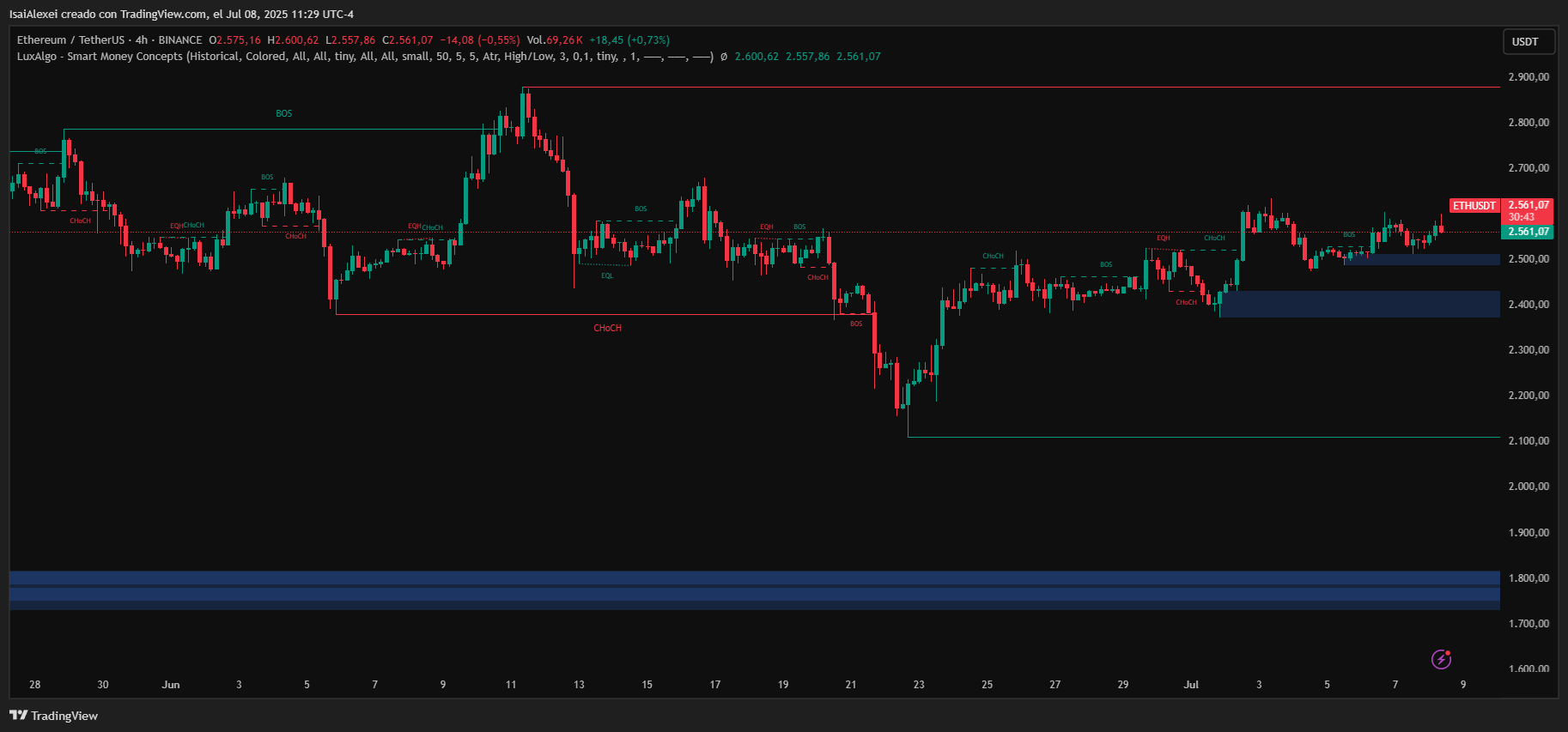
Ethereum is trading near the midpoint of its 30-day range ($2,521–$2,591), showing consolidation just below resistance at $2,600–$2,650. Momentum indicators suggest slight bullish continuation, supported by increased spot trading volume and positive funding rates in futures markets.
ETHNews analysts are closely monitoring the $2,600 breakout level, which, if cleared, could open the door to $2,750–$2,900. On the downside, failure to maintain support at $2,520 may lead to a retest of the $2,400–$2,450 demand zone.
News & Fundamental Drivers
- Bit Digital, a U.S.-based mining firm, recently sold all its BTC holdings and converted to ETH, citing Ethereum’s long-term network value and staking yield as strategic advantages. This marks a significant institutional narrative shift.
- Ethereum remains the most dominant Layer 1 for DeFi, NFTs, and Layer 2 infrastructure. Gas fees remain low (~1.54 GWEI), and L2 rollups such as Arbitrum and Base are contributing to high throughput without overloading the L1.
- Institutional inflows have returned moderately after the May-June correction. ETH’s positive weekly performance is outpacing many other top assets (including BNB and SOL), as ETF speculation continues to re-enter headlines, particularly following ETH’s inclusion in Grayscale’s blended fund products.
- Community sentiment remains bullish with 88% of CoinGecko respondents voting positively on ETH’s outlook. Developers at EthCC continue to advocate for upcoming “sharding” upgrades, which will further reduce validator load and improve L2 interoperability.
Ethereum is in a pivotal zone technically and fundamentally. If it can sustain momentum and break through the $2,600–$2,650 resistance, it could initiate a leg up toward $3,000. Failure to do so may result in continued range trading or minor downside correction.