






According to a report shared by CryptoQuant, Ethereum is displaying on-chain behavior consistent with a potential capitulation phase.
While price has corrected sharply from the $3,000 area toward the $2,000 range, network-level activity has moved in the opposite direction, with token transfers accelerating aggressively.
This divergence between falling price and rising on-chain activity suggests the market is processing an unusually large volume of forced or defensive transactions.
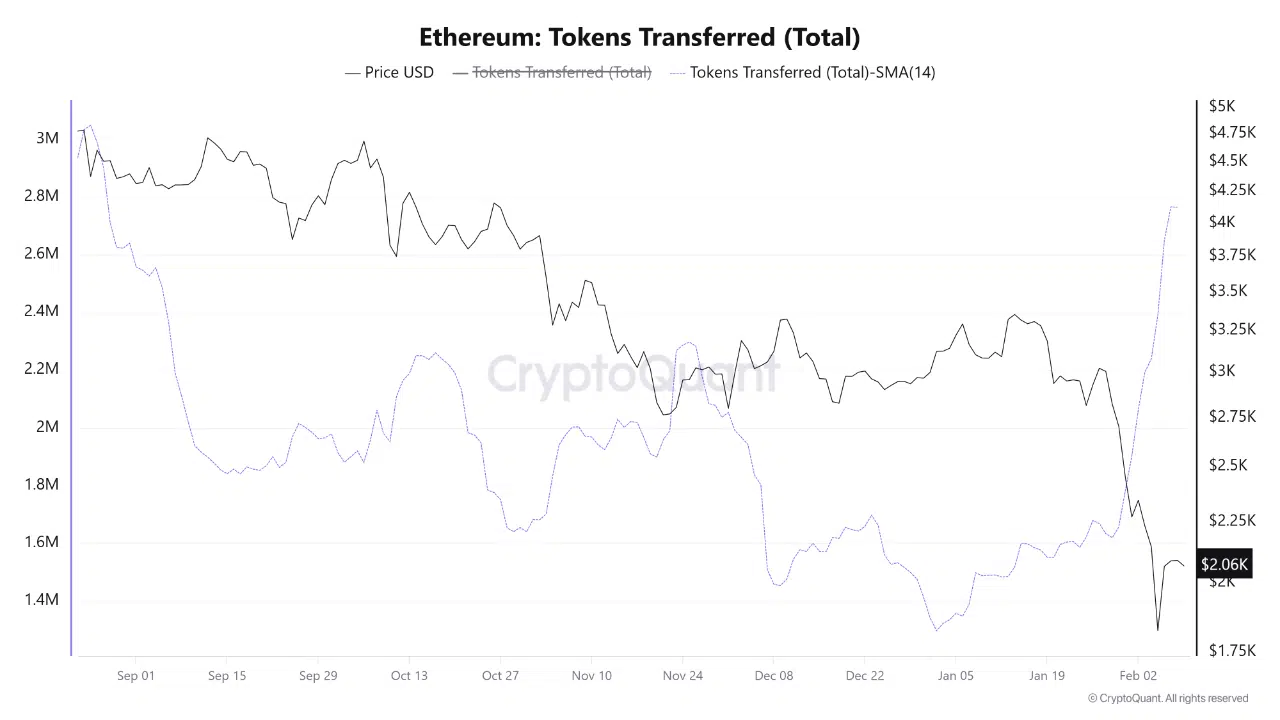
What the Chart Shows
The chart tracks Ethereum’s price alongside the 14-day Simple Moving Average (SMA-14) of Total Tokens Transferred across the network.
- As ETH price declined rapidly, the SMA-14 of token transfers surged from approximately 1.6 million on January 29 to 2.75 million by February 7.
- This represents the highest reading for this metric since August 2025, marking an extreme in transfer activity over a short time window.
Such a sharp acceleration indicates that a large number of tokens changed hands simultaneously while price was under heavy pressure.
On-Chain Interpretation of the Spike
- Panic Selling and Capital Rotation
A rapid increase in ERC-20 token transfers during a price drawdown typically reflects investors exiting risk positions. This often includes conversions into stablecoins, transfers to exchanges for liquidation, or repositioning into lower-volatility assets. - Capitulation Dynamics
Historically, extreme spikes in transfer velocity during bearish price action align with capitulation phases. These events represent the “flushing out” of weaker hands, where a large portion of sell-side pressure is absorbed in a compressed time frame rather than spread gradually. - DeFi-Driven Activity
Because this metric tracks token transfers rather than ETH alone, part of the surge likely reflects liquidations, collateral adjustments, and forced movements within DeFi protocols. Price declines can trigger automated unwinds, amplifying on-chain activity even as market sentiment deteriorates.
Structural Context
The key feature of the current setup is intensity, not duration. The transfer spike occurred rapidly and reached levels not seen for several months, suggesting a concentrated release of selling pressure rather than a slow distribution process.
In prior cycles, similar “blow-off” behavior in token movement during downtrends has often coincided with markets approaching exhaustion rather than the start of prolonged selling phases.



