



- Acceleration track targets confirmations within thirty seconds and slashes Layer-2 settlement delays, replacing seven-day waits with near-real-time experiences.
- Finalisation research explores Beacon Chain changes; Kohaku-style wallets align intents and recovery; August on-chain volume reached $324 billion.
Ethereum’s core developers set a clear timetable to simplify life across Layer-2 networks. The Ethereum Foundation (EF) outlined a user-experience roadmap that targets seamless cross-chain activity and much faster confirmations—cutting practical wait times from roughly 13–19 minutes to about 15 seconds for most interactions, with broader finality work continuing in parallel.
The plan runs in three tracks through 2026: Initialisation, Acceleration, and Finalisation. First, EF teams will introduce an Open Intents Framework so users state desired outcomes—swap, bridge, or pay—and the system routes to the best path across L2s such as Arbitrum, Base, and Polygon.
In tandem, engineers will build an Ethereum Interoperability Layer (EIL). The goal is simple: make transactions across L2s feel like operating on one chain while preserving “CROPS” values—censorship-resistance, open-source, privacy, and security.
Next, the Acceleration track targets faster block confirmations in the 15–30 second range and shorter L2 settlement windows, which can currently stretch up to seven days. The EF expects material reductions by early 2026.
Finally, the Finalisation stream advances research on L1 finality itself, including changes under consideration for the Beacon Chain, alternatives to the current three-slot finality, and consensus options that could drive confirmation certainty down to seconds.
The roadmap also touches wallets
EF protocol co-lead Barnabé Monnot flagged new designs—including the privacy-oriented Kohaku—to align signing, recovery, and intent execution with cross-chain use. Treasury operations have been reshaped as well, with EF allocating through Ethereum-based finance rails to match the network’s own ethos.
Liquidity has fragmented across L2s; users face multiple bridges, fee markets, and settlement delays. By abstracting routes and compressing latency, EF is trying to turn today’s patchwork into a single, coherent surface. Like smoothing a rail yard, fewer switches should mean fewer errors and lower costs.
On-chain activity supports the push
Ethereum processed about $324 billion of volume in August, the third straight monthly rise. If usage holds and the roadmap ships on schedule, the network could convert complexity into throughput, with UX that reads as one chain—regardless of how many rollups sit underneath.
Ethereum (ETH) Price – August 28, 2025
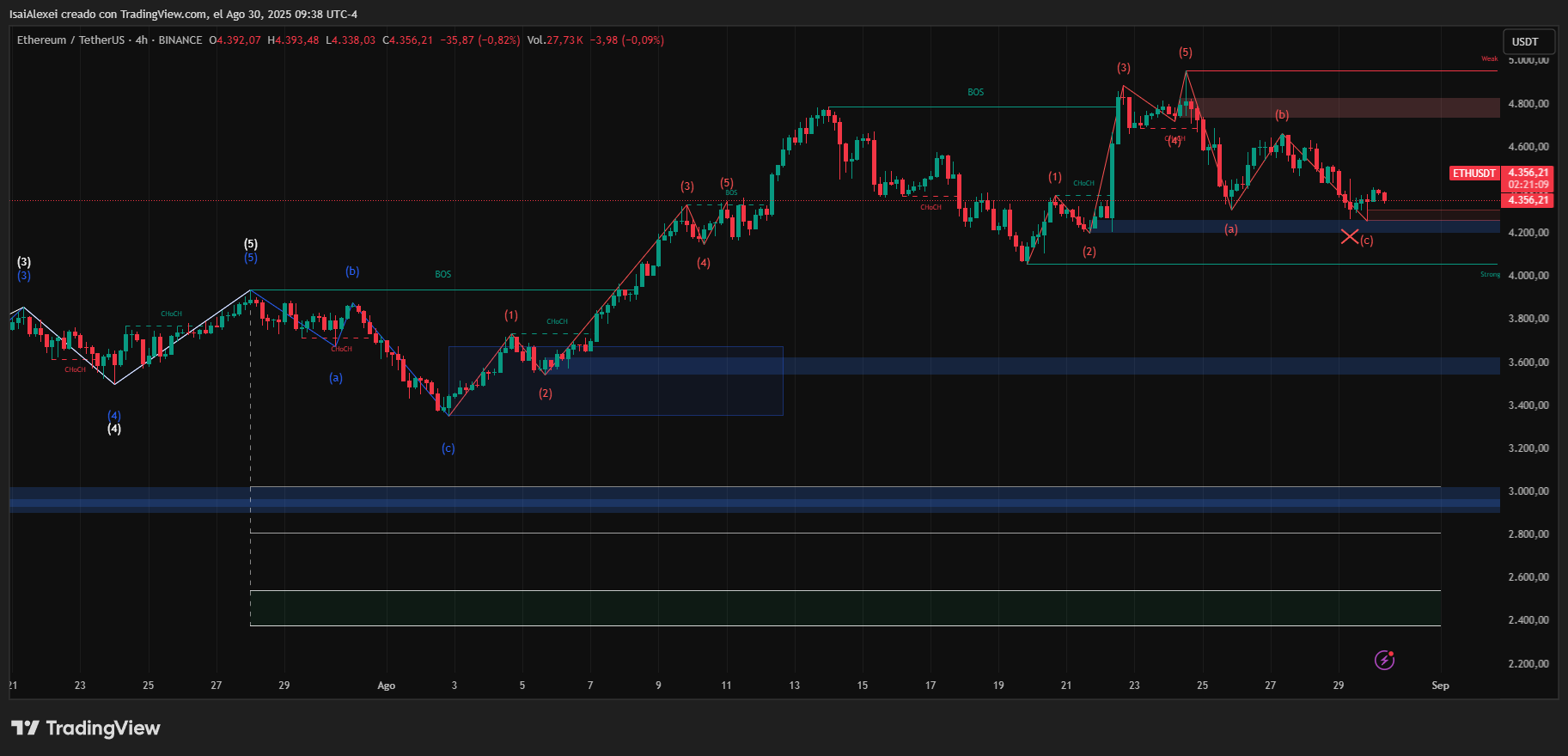
Ethereum (ETH) is trading at $4,352.01 USD, reflecting a -1.03% decline in the last 24 hours and a -7.61% drop over the past 7 days. Its market capitalization is $525.9 billion, with a 24-hour trading volume of $30.39 billion.
ETH maintains its position as the second-largest cryptocurrency, holding 13.7% of market dominance, behind Bitcoin’s 56.2%. The circulating supply is 120.7 million ETH, with no maximum supply limit.
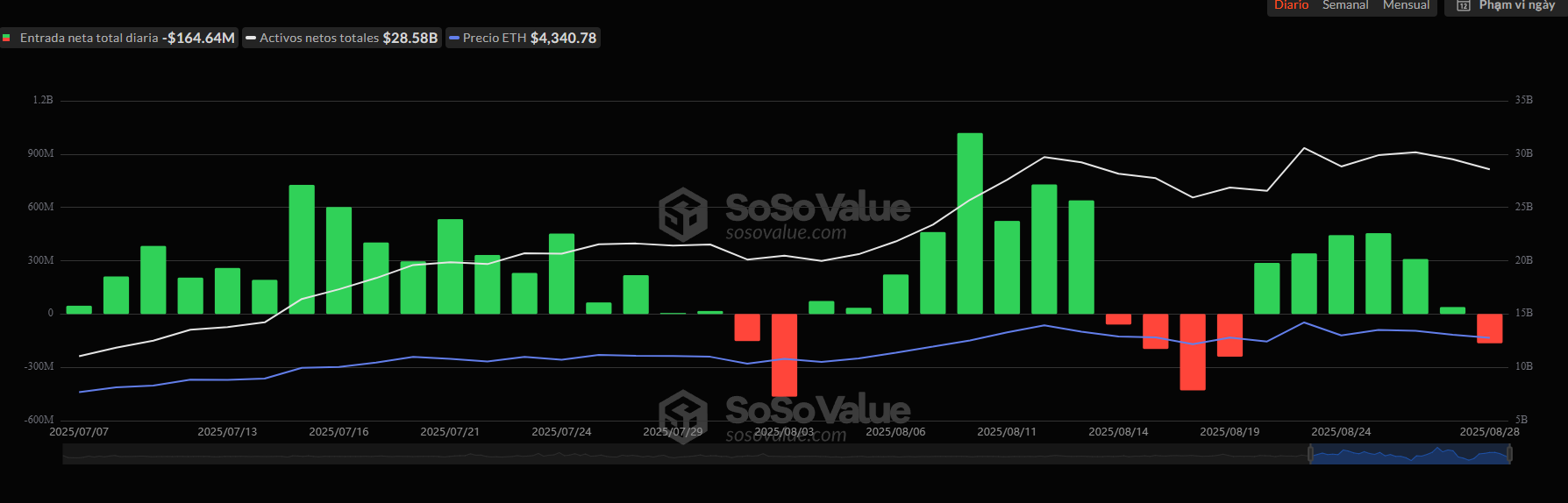
The latest updates today reveal that Ethereum spot ETFs have attracted $13.7 billion in inflows this August, marking a new record. On August 11th, ETH registered its highest single-day inflow of over $1 billion, fueled by institutional demand.
At the same time, Ethereum unveiled its 2026 UX roadmap, focused on Layer 2 interoperability and targeting a 98% improvement in user-perceived latency, which could transform decentralized application usability.
On the financial side, Ethereum has outpaced Bitcoin in ETF inflows, with over $4 billion in net gains during August, while Bitcoin products recorded $600 million in outflows. This demonstrates increasing institutional confidence in ETH as a strategic asset for both investment and infrastructure settlement.




