





The broader crypto lending market has been contracting since October 2025, with total deposits falling 35% from their highs. Morpho, Maker, and Jupiter Exchange have been moving in the opposite direction, and the numbers behind that divergence are worth understanding.
The Sector Versus the Outliers
According to Artemis data, the three protocols grew their combined lending deposits from $18.4 billion to $20.9 billion, a 13.6% increase during a period when most of the sector was losing ground. That kind of counter-trend growth does not happen by accident. It reflects genuine user preference shifting toward specific platforms while others shed deposits.
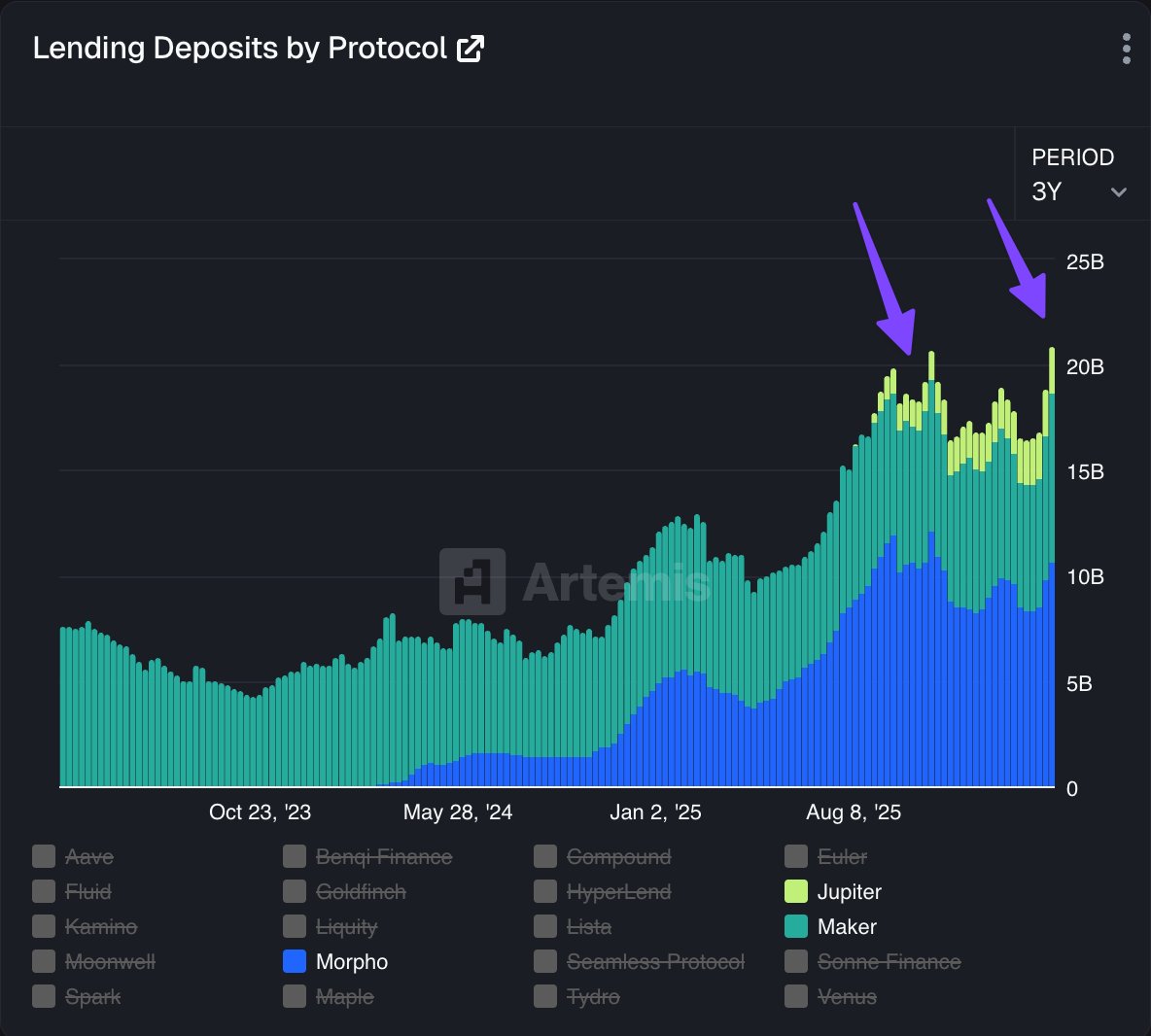
The three protocols tell different stories within that aggregate number. Morpho sits at $10.7 billion, roughly flat over the period but still holding the second-largest lending deposit base in DeFi. Stability at that scale during a sector-wide contraction is itself a form of outperformance. Losing nothing while competitors lose 35% is a real result.
Maker grew from $6.4 billion to $8.0 billion, a 25% increase. That growth lands in a protocol that has been one of DeFi’s foundational infrastructure layers since 2017, suggesting its user base is not speculative tourists who leave during drawdowns. They stayed and added.
Jupiter Exchange is the most striking figure. Deposits grew from $1.3 billion to $2.2 billion, a 69% increase from the smallest base of the three. Jupiter operates primarily on Solana / SOL, and its lending growth reflects the broader expansion of Solana’s DeFi ecosystem even as Ethereum-based protocols navigated a more difficult environment.
What the Chart Shows
The Artemis lending deposits chart covering three years puts the current moment in context. Total deposits across tracked protocols were near zero at the start of 2023, grew steadily through 2024, and then accelerated sharply into the October 2025 peak near $25 billion. The subsequent contraction pulled the aggregate back toward $20 billion, which on the chart still looks elevated relative to anything seen before mid-2025.
The composition of that $20 billion has changed, though. The protocols that grew through the drawdown now represent a larger share of a smaller total. That concentration is visible in the chart’s stacked bars, where the blue representing Morpho and the teal representing Maker dominate the current column in a way they did not at the October peak.
Why This Divergence Matters
A 35% sector decline in lending deposits is not a minor adjustment. It represents a meaningful withdrawal of capital from DeFi lending infrastructure, likely driven by a combination of falling collateral values, reduced leverage appetite, and broader risk-off positioning that has characterized the market since October.
The protocols that grew through that environment share some common characteristics. Morpho has built a reputation for capital efficiency and risk-adjusted yield that attracts more sophisticated depositors. Maker’s DAI infrastructure is embedded deeply enough in DeFi that its deposit base has structural stickiness. Jupiter’s growth reflects platform-level momentum on Solana rather than just lending-specific dynamics.
What the data does not tell you is whether the three outliers are capturing genuine long-term users or whether their growth will reverse as the sector stabilizes. A 69% increase for Jupiter during a drawdown raises the question of whether that capital chased yield during a period of elevated rates on the platform or whether it represents durable user acquisition. The distinction matters for whether these numbers look the same six months from now.
What is clear is that the narrative of a uniform DeFi lending contraction does not hold up against the protocol-level data. Some platforms are growing. They just happen to be the ones that were already the strongest going in.



