





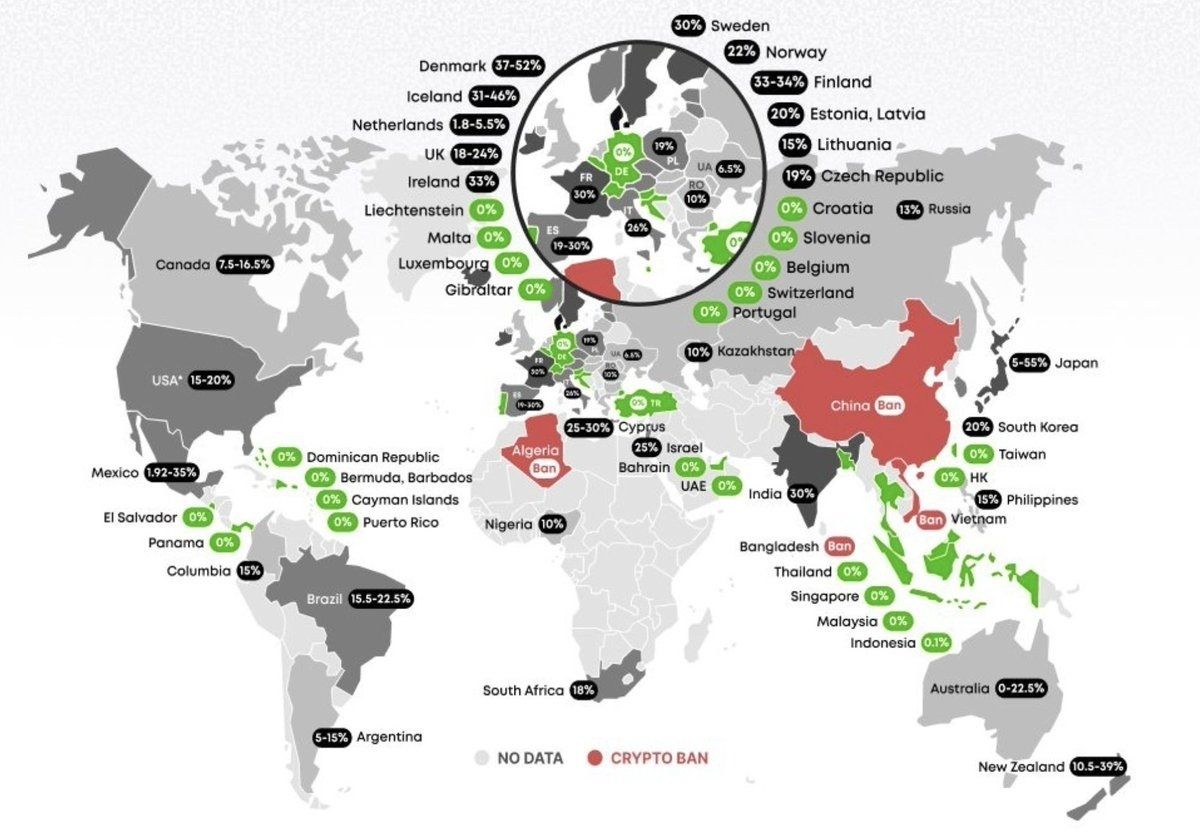
As of February 2026, several jurisdictions continue to maintain 0% tax treatment on Bitcoin and other cryptocurrencies for individual investors.
However, the distinction between passive holding and professional trading remains central in many countries, and new regulatory adjustments are narrowing blanket exemptions.
Below is a structured overview of current zero-tax environments and where conditions apply.
Countries With 0% Tax (No Major Conditions)
These jurisdictions generally exempt personal crypto investments from both capital gains and income taxes.
United Arab Emirates
Offers 0% personal income and capital gains tax on crypto for individuals.
Starting in 2026, businesses with profits exceeding AED 375,000 are subject to a 9% corporate tax.
El Salvador
Bitcoin is legal tender. Capital gains and income derived from Bitcoin are 100% tax-exempt for both residents and foreign investors.
Cayman Islands
No personal income, corporate, or capital gains taxes.
Singapore
No capital gains tax. Individual investment profits are tax-free. Professional trading may be taxed as business income (up to 24%).
Hong Kong
0% tax on long-term personal crypto gains.
In February 2026, the government moved to formally extend exemptions to institutions.
Countries With 0% Tax for Long-Term Holding (“HODLing”)
These jurisdictions exempt crypto gains only if held for a minimum duration.
Portugal
0% tax on crypto held longer than 365 days, short-term disposals are taxed at a flat 28%.
Germany
Tax-free if held more than one year. Shorter holding periods are taxed at progressive income rates up to 45%.
Conditional or Specialized Zero-Tax Zones
These regions provide zero capital gains tax under structured conditions.
Switzerland
Private investors typically pay 0% capital gains tax if they qualify as non-professional traders.
However, annual wealth tax (typically 0.3%–1%) applies to total assets, including crypto.
Puerto Rico
Under Act 60, qualifying residents can eliminate U.S. federal capital gains taxes on crypto acquired after establishing residency, provided residency requirements are met.
Regulatory Shifts in 2026
Several countries that previously maintained 0% environments have introduced changes:
Slovenia
Proposed a 25% flat tax on crypto-to-fiat gains effective January 1, 2026.
Cyprus
Introduced an 8% flat tax on crypto disposal profits starting January 1, 2026, replacing its prior 0% status.
Global Reporting Expansion
In 2026, more than 40 countries began collecting crypto transaction data under the OECD’s Crypto-Asset Reporting Framework (CARF). The first automated cross-border information exchanges are expected in 2027, signaling tighter global transparency standards even in low-tax jurisdictions.
Key Takeaway
While several countries still offer 0% crypto tax environments in 2026, most regimes now distinguish between passive holding and active trading. Long-term holding remains the most common path to tax exemption, and regulatory reporting standards are tightening globally.



