


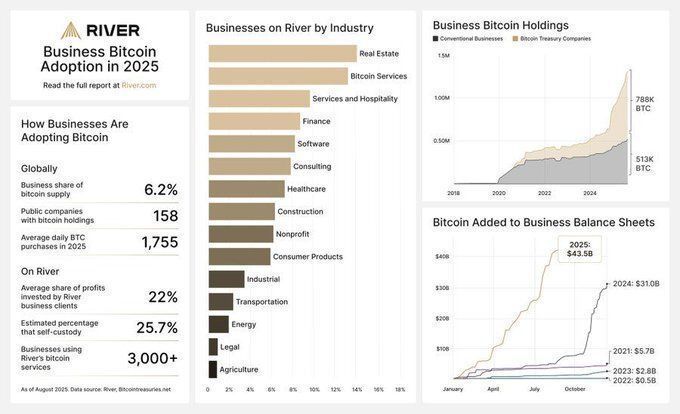
According to a new report from River, corporate Bitcoin accumulation has reached unprecedented levels in 2025, with businesses collectively purchasing an average of 1,755 BTC per day. That figure is nearly four times higher than the roughly 450 BTC mined daily, signaling what analysts are calling a potential supply shock in the making.
Bitcoin Business Adoption Accelerates Globally
River’s “Business Bitcoin Adoption in 2025” report highlights how institutional demand has become a dominant driver of Bitcoin’s supply dynamics. Globally, 6.2% of all Bitcoin is now held by businesses, and 158 publicly listed companies currently report Bitcoin on their balance sheets.
The report also shows that over 3,000 businesses use River’s Bitcoin services, with an average of 22% of profits being reinvested into BTC. Notably, 25.7% of these companies choose self-custody, indicating growing maturity in treasury management and long-term conviction in Bitcoin’s role as a corporate reserve asset.
Real Estate and Finance Lead the Adoption Wave
Breaking down adoption by sector, River found that real estate firms lead corporate Bitcoin usage, followed closely by Bitcoin service providers, finance, software, and hospitality industries. This diversification suggests Bitcoin is no longer confined to fintech startups or miners, it’s entering the operational core of multiple global sectors.
Meanwhile, cumulative business Bitcoin holdings have surged to 1.3 million BTC, with 788,000 BTC held by treasury-focused companies such as MicroStrategy and 513,000 BTC by conventional businesses.
From Treasury Strategy to Supply Crisis
The data paints a clear picture: companies are accumulating Bitcoin faster than new supply can enter the market. With 1,755 BTC purchased daily against only 450 BTC mined, the resulting deficit underscores the tightening available float.
According to River, Bitcoin added to corporate balance sheets in 2025 has already reached $43.5 billion, up from $31 billion in 2024 and $5.7 billion in 2023.
If this rate continues, analysts predict a growing imbalance between demand and new issuance, potentially creating the kind of supply-side pressure that historically precedes major bull runs.
Institutional Accumulation Reshaping Bitcoin’s Market Structure
River’s findings suggest Bitcoin is undergoing a structural transition from a speculative asset to a strategic reserve instrument for corporations seeking an inflation hedge and independent store of value.
As River concluded, “Businesses are no longer testing Bitcoin, they’re competing for it.”
With company purchases outpacing mining by nearly 4-to-1, the market may be approaching a new inflection point, where institutional hoarding meets dwindling supply, setting the stage for the next wave of Bitcoin’s price acceleration.