






On-chain data shows a growing divergence in Cardano’s investor behavior, with large holders steadily increasing exposure while smaller wallets reduce positions amid recent price weakness.
According to data shared by Santiment, wallets holding between 100,000 and 100 million ADA have been aggressively accumulating during the latest market pullback. This accumulation phase has unfolded even as ADA’s price declined from above $0.40 earlier in the month to around $0.35 at the time of observation.
Smart Money Accumulation Accelerates
Santiment’s on-chain metrics indicate that so-called “smart money” wallets added approximately 454.7 million ADA over the past two months, spanning from late November 2025 through January 2026. At current prices, this accumulation represents roughly $161 million in net inflows.
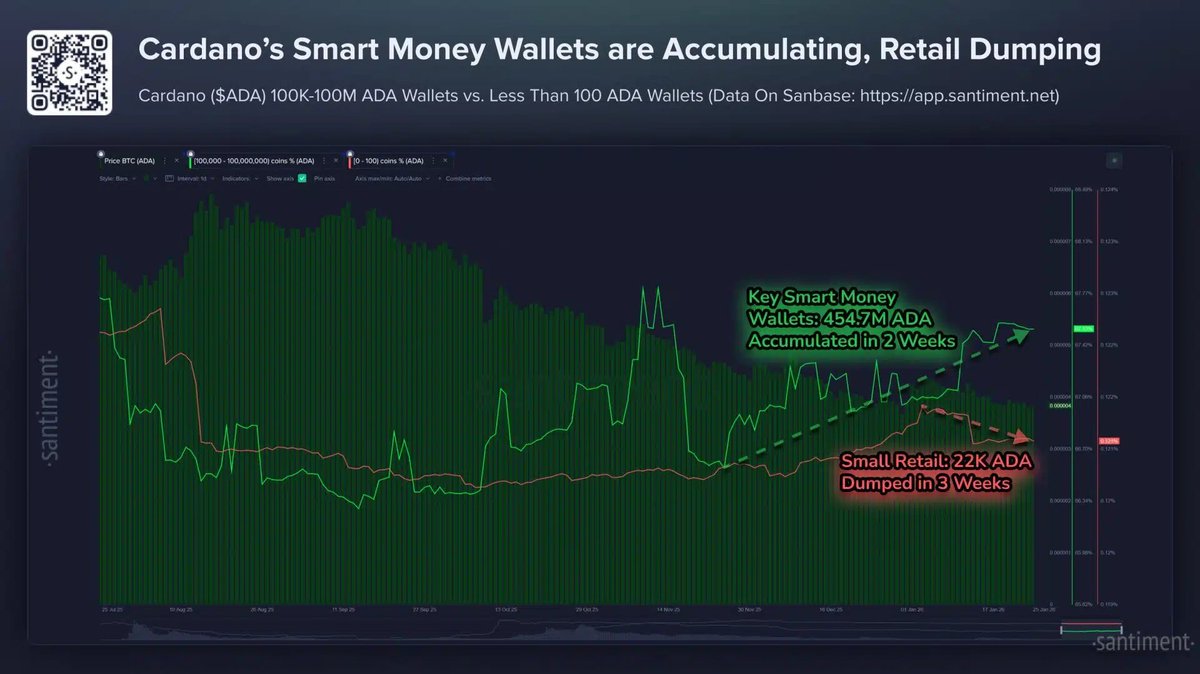
As a result, these large holders increased their share of Cardano’s circulating supply from about 66.3% to 67.53%, bringing their total holdings to approximately 24.33 billion ADA. The steady rise in whale ownership suggests growing conviction among long-term investors, despite the broader market’s corrective phase.
Historically, sustained accumulation by large wallets during periods of price weakness has often coincided with longer-term positioning rather than short-term speculation, signaling patience rather than panic among this cohort.
Retail Investors Continue to Reduce Exposure
In contrast, smaller retail wallets have moved in the opposite direction. Data shows that addresses holding 100 ADA or less collectively sold around 22,000 ADA over the past three weeks, equivalent to roughly $7,800 at current prices.
This selling reduced retail investors’ share of the circulating supply from approximately 0.122% (43.96 million ADA) to 0.121% (43.6 million ADA). While the absolute volume is small compared to whale activity, the trend highlights risk-off behavior among smaller participants during periods of heightened uncertainty.
What the Divergence Signals
The growing gap between whale accumulation and retail distribution reflects a familiar on-chain pattern during market corrections. Large holders appear to be using lower prices to build positions, while smaller investors prioritize capital preservation after sustained downside pressure.
If historical behavior holds, continued accumulation at these levels may indicate confidence in Cardano’s longer-term outlook, even as near-term price action remains constrained. However, until broader market conditions stabilize, this divergence underscores a cautious environment where conviction is concentrated among larger, longer-term holders rather than the retail crowd.



