
- Cardano opened Ouroboros Leios for public review, inviting scrutiny of specifications, mini-protocols, trade-offs, and throughput goals from stakeholders.
- Developers target faster confirmation and efficiency while preserving decentralization and security; dApp disruption minimized, failed transactions support added.
Cardano has moved the “Ouroboros Leios” upgrade into public review, opening its design to holders, validators, and builders. The Cardano Foundation’s repository now hosts the proposal and supporting materials.
Nicolas “BeRewt” Biri, Director of Software Architecture at Input Output, said the team wants broad scrutiny before code lands on mainnet. The draft also adds handling for failed transactions and aims to avoid disruption to existing dApps.
So, here it is, we know have a public and submitted CIP for Leios. More than ever, it's now time for feedback.https://t.co/s3aCAHBfyK
It may be too early to celebrate, as we want to be sure that the community agrees on it first, but it's a huge milestone.— Nicolas `BeRewt` Biri (@BeRewt) August 27, 2025
Leios targets higher throughput while keeping the chain’s security guarantees intact. Reviewers are asked to assess formal specifications, mini-protocols, and the trade-offs behind the approach.
The design frames speed as a bounded goal: Cardano will not chase headline latency if it means weakening decentralization or raising operational fragility. In plain terms, the network accepts guardrails on performance to keep verification reliable and participation open.
Some users asked whether matching Solana’s speed would require similar concessions. Biri replied that Cardano’s security model rules out certain shortcuts; copying them would compromise the chain’s values. Under Leios, block finality and script budgets may see efficiency gains, but not at the expense of auditability or validator inclusivity.
Compromising anything how it would be different from Solana? All these days finger was pointed on them now we also saying we need to compromise. Is Solana understood and solve this problem best way possible much ahead of time?
— AR (@ashishranjan04) August 28, 2025
Funding is in place for the next phase. Earlier in August, token-holder governance approved 96 million ADA—about $71 million—to support a year of core work. It is the first direct allocation of treasury funds to base-layer development, setting a clear runway for engineering, testing, and audits.
Next steps revolve around feedback, implementation detail, and staged rollouts. The team plans to submit the pull request this quarter, then iterate based on findings from test environments.
If reviewers confirm the expected benefits—lower latency, better bandwidth use, and reduced on-chain voting overhead—Leios would arrive as a performance upgrade defined by restraint. Rather than chasing peak benchmarks, Cardano is attempting to raise throughput within its existing trust model, so the chain feels faster without asking users to accept new risks.
Cardano (ADA) Price – August 28, 2025
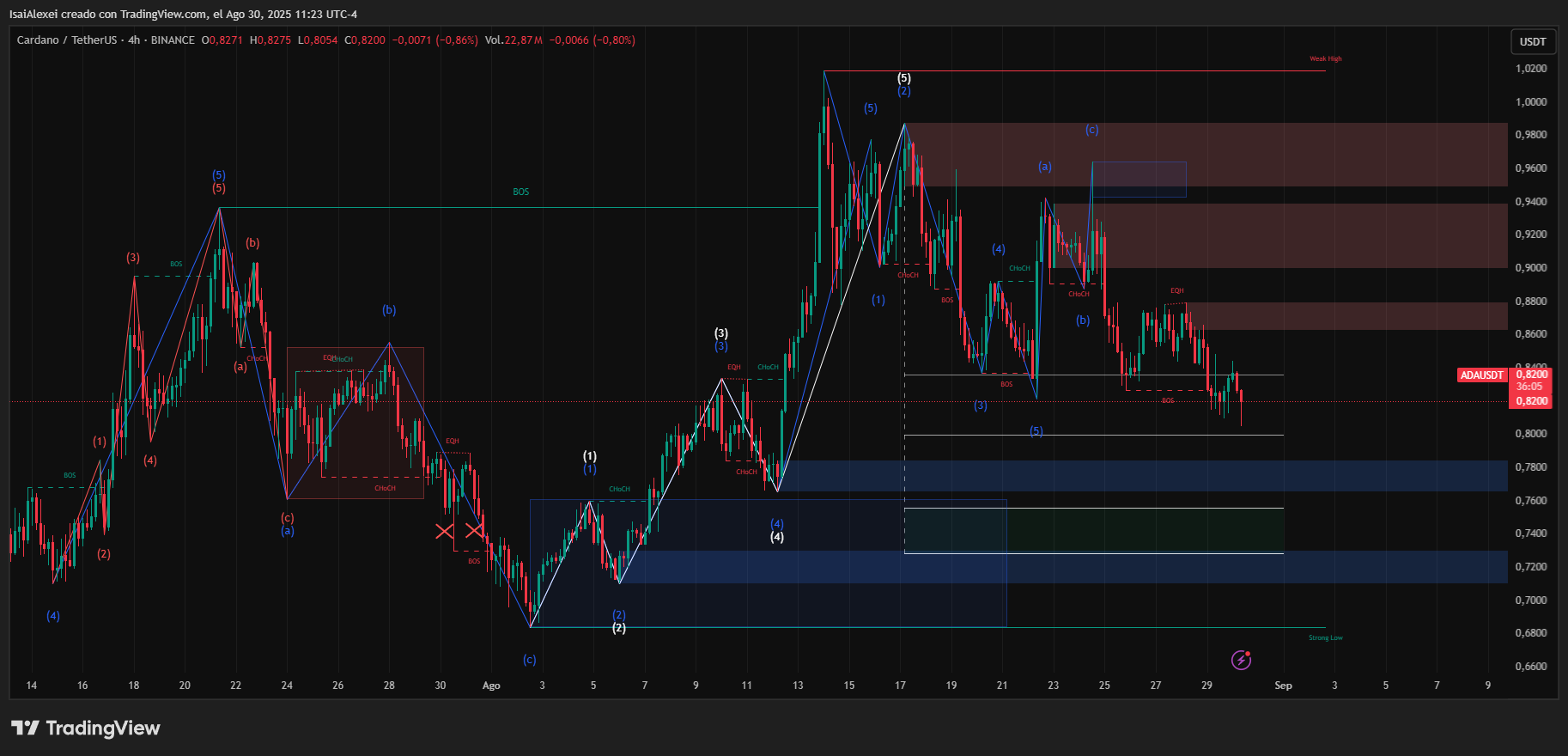
Cardano (ADA) is currently trading at $0.8158 USD, reflecting a -1.38% decline in the last 24 hours and a -10.73% drop over the past 7 days. With a market capitalization of $29.7 billion and a 24-hour trading volume of $1.36 billion. The circulating supply is 36.48 billion ADA, with a maximum supply capped at 45 billion tokens.
The latest updates today include three major developments. First, Grayscale has filed for a Cardano Spot ETF with the U.S. SEC, which, if approved, could attract institutional inflows into ADA and strengthen its market presence.
Second, the Ouroboros Leios Improvement Proposal (CIP) has gone live in Cardano’s repository, inviting community feedback on the next major upgrade focused on performance and scalability.
Third, ADA’s price action reflects weak demand, with analysts noting that holders are exploring alternative investments, leading to price stagnation near the $0.82 resistance zone.