






The real-world asset (RWA) narrative is moving from theory to execution, and recent data highlights a clear leader.
According to the latest on-chain snapshots, Canton Network has rapidly positioned itself at the center of institutional tokenization, far ahead of competing blockchains.
With hundreds of billions of dollars already represented on-chain and direct integration with traditional financial infrastructure, Canton is no longer an experimental platform. It is becoming foundational plumbing for regulated finance moving on-chain.
RWA Data Shows a Massive Gap Between Canton and Other Chains
The network comparison data shows a striking concentration of tokenized value. Canton alone accounts for approximately $388 billion in represented real-world assets, dwarfing every other listed network.
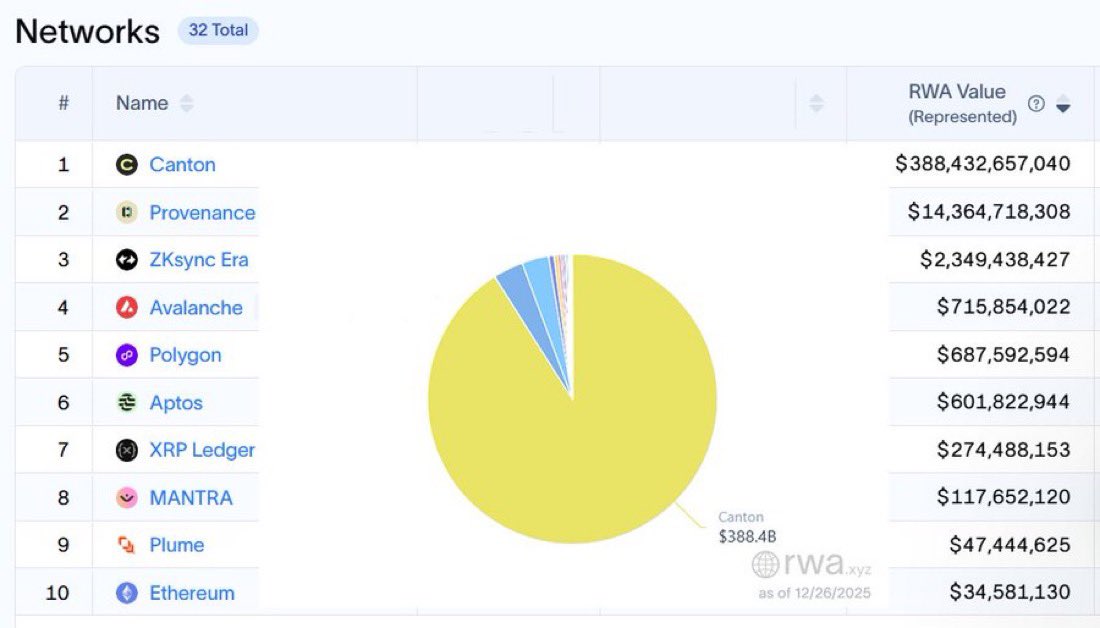
The second-largest chain in the ranking sits at roughly $14 billion, highlighting how early-stage and fragmented the broader RWA landscape still is. Other well-known ecosystems appear much further down the list, each representing only a fraction of Canton’s on-chain value.
This gap is not incremental. It is structural. Canton is operating on a completely different scale, driven by institutional-grade adoption rather than retail experimentation.
DTCC Partnership Pushes Tokenization Into the Financial Core
Momentum accelerated further after confirmation that DTCC, which clears roughly $4 quadrillion annually, is partnering with Canton Network to tokenize U.S. Treasury securities.
🚨 BREAKING: DTCC (clearing $4 quadrillion annually) partners with Canton Network to tokenize US Treasury securities.
Authorized for 3 years, starting H2 2026 across, L1/L2 blockchains.
DTCC can now tokenize real-world assets at scale.
The infrastructure is going on-chain. pic.twitter.com/WE2gI3sgY7
— Real World Asset Watchlist (@RWAwatchlist_) December 20, 2025
The authorization spans three years, beginning in the second half of 2026, and applies across both Layer 1 and Layer 2 environments. The implication is significant: real-world financial infrastructure is not testing tokenization at the edges, it is preparing to deploy it at scale.
This move effectively signals that large portions of traditional settlement, clearing, and collateral systems are preparing to migrate on-chain.
CC Price Structure Reflects Strong Momentum With Elevated Volatility
The CC/USDT chart shows a clear upward structure on the 4-hour timeframe, with price advancing into the $0.11–$0.12 zone. Recent candles reflect strong directional momentum, supported by visible volume expansion during upside moves.
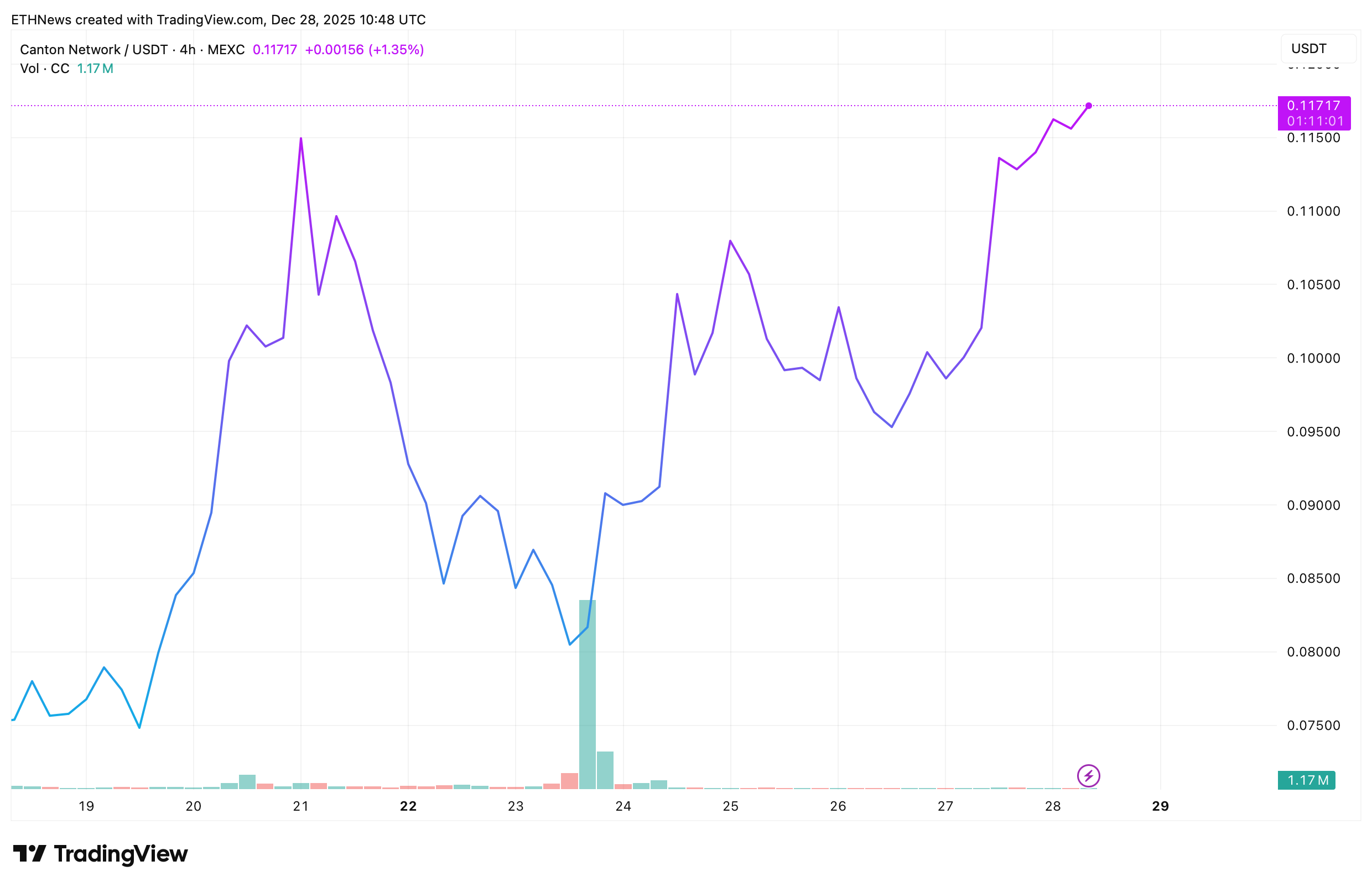
At the same time, volatility metrics remain elevated, signaling that while momentum is constructive, price discovery is still aggressive. This aligns with early-stage infrastructure narratives, where positioning adjusts rapidly as new information is absorbed.
Importantly, sentiment indicators shown alongside the chart lean bullish, despite broader market fear readings remaining in extreme territory. That divergence often appears when capital rotates selectively into emerging narratives rather than the market as a whole.
What the Market Is Really Pricing In
The data does not suggest speculative hype alone. Instead, it reflects a repricing of infrastructure relevance.
Canton is not competing for users or retail attention. It is competing for institutional settlement, compliance, and asset issuance workflows. The scale of tokenized value already present implies that much of this adoption is happening quietly, before broader narratives catch up.
Unlike previous RWA cycles focused on pilots, this phase is defined by execution, permissions, and regulatory alignment, areas where Canton appears to have an early and durable lead.
Thinking Ahead: Why This Matters Beyond Short-Term Price
If tokenization becomes embedded into traditional finance, not as an add-on, but as core infrastructure, then networks already integrated with clearing and settlement giants may capture disproportionate long-term value.
Canton’s current dominance suggests that the RWA race may not be about which blockchain is fastest or cheapest, but which one institutions trust to move real capital at scale.
The market is still early in fully pricing that distinction.



