





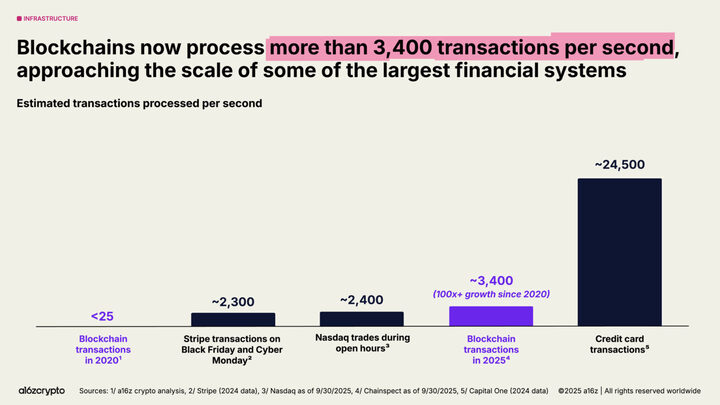
In a groundbreaking milestone for digital infrastructure, blockchains have officially overtaken Nasdaq in transaction speed, now handling over 3,400 transactions per second (TPS) compared to the stock exchange’s average of ~2,400 TPS, according to new data shared by a16z crypto.
This marks a 100x increase in blockchain processing capacity since 2020, when the industry averaged fewer than 25 transactions per second. The acceleration reflects massive scalability upgrades, layer-2 network innovations, and the rise of modular architectures designed to rival traditional financial systems.
From Experimental Networks to Financial-Grade Infrastructure
Just five years ago, blockchain technology struggled with congestion and high fees during major events like DeFi summer or NFT mania. Now, transaction throughput has surpassed even major market exchanges like Nasdaq, pushing decentralized infrastructure into a new phase of institutional readiness.
According to a16z’s analysis, this throughput boom stems from a combination of layer-2 rollups, parallelized execution engines, and optimized consensus mechanisms adopted across leading networks. Solutions like Solana’s local fee markets, Arbitrum’s compressed batching, and Celestia’s modular data availability have made near-instant settlement not only possible but routine.
Benchmarking Against Traditional Systems
In the comparison chart, blockchain transaction rates now sit between Stripe’s 2,300 TPS (recorded during Black Friday and Cyber Monday peaks) and credit card networks’ ~24,500 TPS. While payment giants still lead in total throughput, the pace of blockchain growth, from 25 to 3,400 TPS in just half a decade, suggests convergence could occur within the next few years.
This surge has also caught the attention of regulators and infrastructure providers, as it signals that blockchain systems are no longer experimental sandboxes but maturing settlement layers capable of competing with traditional rails.
Implications for Global Finance
Industry analysts believe this performance leap could accelerate tokenized asset trading, real-time settlement, and cross-border payments, directly challenging legacy intermediaries. With Nasdaq itself exploring tokenized equity infrastructure and major custodians entering the space, the line between centralized finance and decentralized systems is rapidly blurring.
If current growth trends continue, blockchains could soon approach, or even exceed, the 24,000 TPS benchmark of major credit card networks, effectively matching global financial throughput on open, permissionless rails.
The data underscores a simple reality: blockchain scalability is no longer a future promise, it’s here, and it’s outpacing Wall Street.



