





According to a report shared by CryptoQuant, Bitcoin may be moving closer to the early stages of a new winter phase, even as prices remain historically elevated.
The key risk highlighted is not an abrupt collapse, but a structural transition where supply-demand dynamics, capital flows, and sentiment weaken before price fully reflects the change.
This interpretation challenges the dominant market narrative that the current pullback represents a routine correction within an intact bull trend.
Why the “Winter” Narrative Is Being Dismissed
Market participants are understandably resistant to the idea of another winter phase. Memories of 2022 remain fresh, and Bitcoin’s nominal price is far higher than during the previous downturn. In addition, the market has matured structurally, with spot ETFs, broader institutional participation, and improved infrastructure reinforcing the perception that conditions are fundamentally different.
However, the report emphasizes that Bitcoin winters are not defined by absolute price levels, but by changes in sentiment, capital behavior, and internal momentum. Historically, these shifts often begin while price still appears resilient.
What the Chart Shows
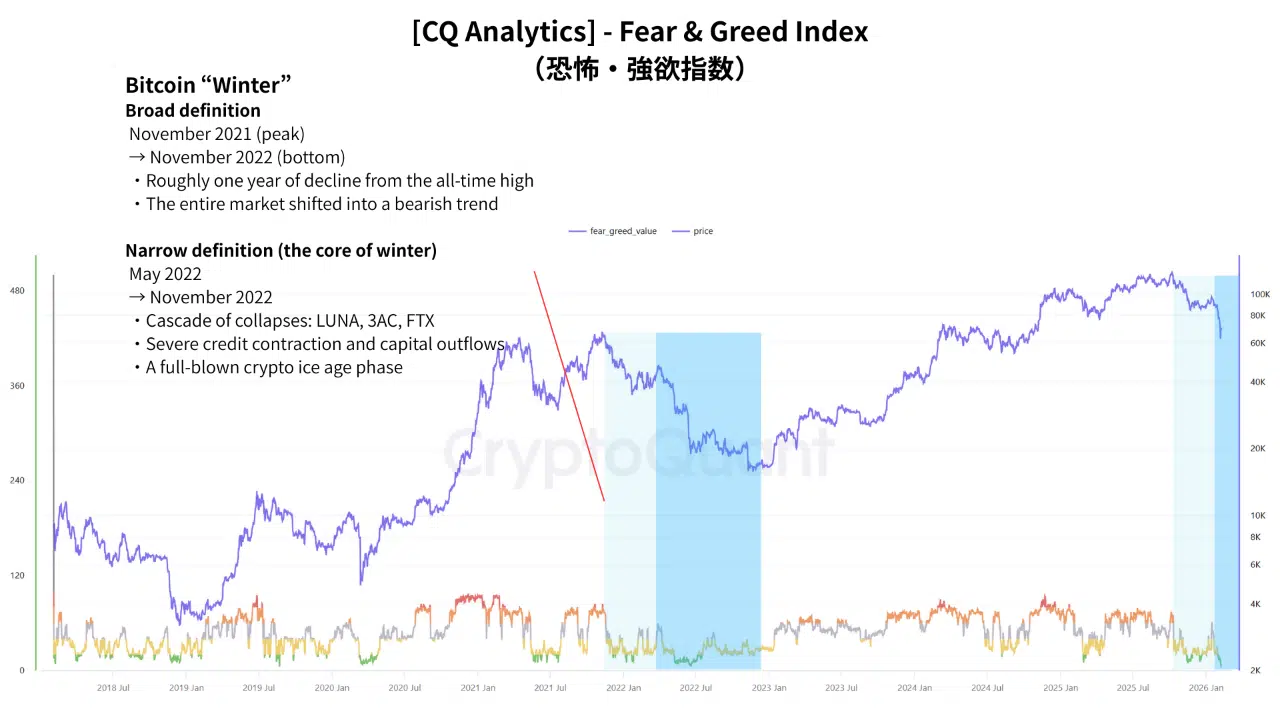
The chart combines Bitcoin price with the Fear & Greed Index, highlighting both broad and narrow definitions of the last Bitcoin winter.
- Broad winter (November 2021 → November 2022):
A prolonged decline from the all-time high, marked by a full market trend shift. - Core winter (May 2022 → November 2022):
The most severe phase, characterized by cascading failures (LUNA, 3AC, FTX), credit contraction, and widespread capital outflows.
The current reading shows the Fear & Greed Index at 14, firmly in Extreme Fear, despite Bitcoin trading far above prior winter price levels. This mirrors past cycles, where sentiment deteriorated first and price followed later.
Capital Flows Tell a Different Story Than Price
Flow data reinforces the structural concern. In 2024, approximately $10 billion in inflows coincided with market capitalization expansion. In contrast, during 2025, more than $300 billion in inflows occurred alongside a decline in market cap, indicating that persistent selling pressure absorbed new capital rather than allowing it to drive sustained appreciation.
This divergence suggests that incremental demand is increasingly being met by distribution rather than expansion.
On-Chain Profitability Is Weakening
The report also points to declining realized profits on-chain, even at elevated price levels. This signals fading internal momentum, where fewer participants are realizing meaningful gains relative to previous phases of the cycle. Historically, this condition has aligned with transitions away from expansionary regimes.
Structural Interpretation
Taken together, sentiment collapse, flow inefficiency, and weakening realized gains point toward a market that is structurally softer than price alone suggests. The base scenario outlined in the report is not an immediate breakdown, but a gradual recognition phase where winter dynamics emerge while prices remain deceptively high.
This view would need to be reassessed if ETF inflows stabilize meaningfully and on-chain distribution clearly subsides, restoring balance between demand and supply.
Takeaway
Bitcoin’s current market structure resembles the early recognition phase of winter, where sentiment and capital behavior deteriorate ahead of price. Elevated prices and stronger infrastructure may delay full acknowledgment, but historical patterns suggest that winter conditions are defined by internal dynamics, not by where price happens to be trading.



