


According to CryptoQuant, Bitcoin’s Sharpe Ratio has dropped into a zone that historically appears only during extreme market stress, moments when risk has already been absorbed rather than just beginning.
The Sharpe Ratio measures return relative to volatility. When it falls below zero, it means investors are taking risk without being compensated. That condition is rare, and it has only occurred a handful of times since 2018.
Why This Matters
Every previous instance of a deeply negative Sharpe Ratio coincided with late-stage drawdowns, not early-cycle weakness.
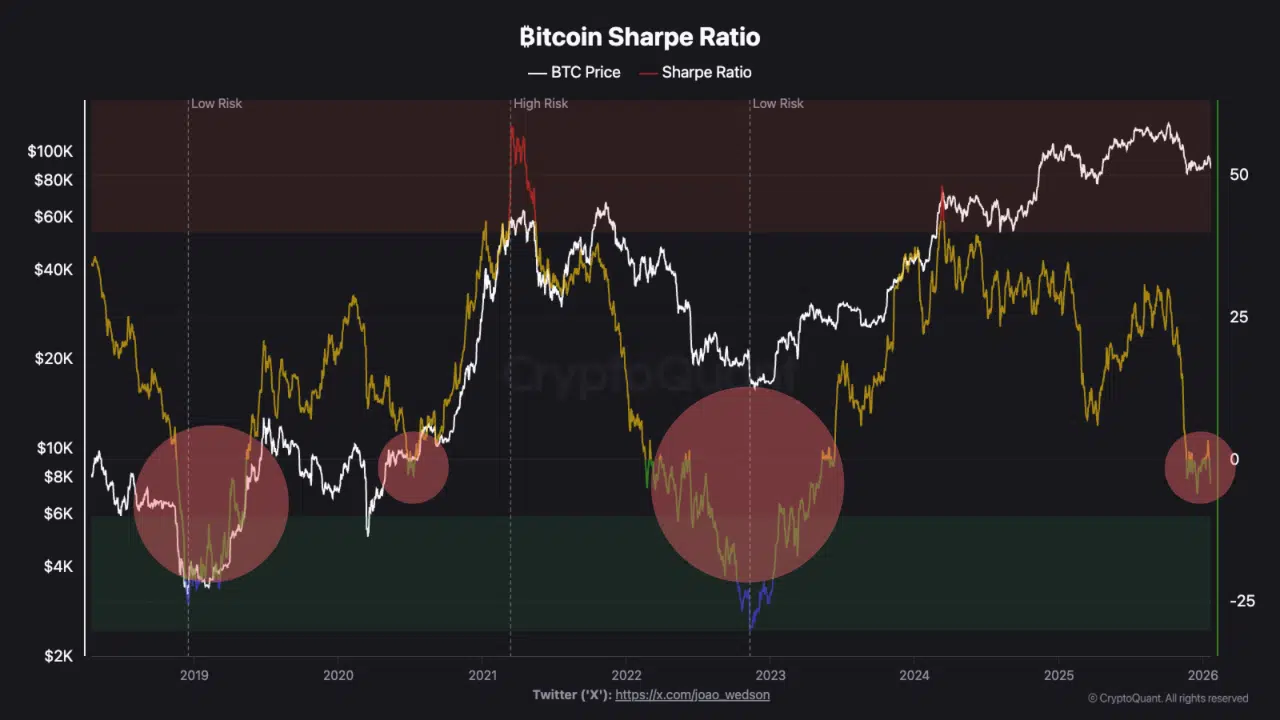
In past cycles, these readings appeared:
- After the 2018 capitulation
- During the COVID shock in 2020
- Throughout the 2022–2023 FTX-driven unwind
Each time, price eventually moved higher after extended consolidation – not immediately, but once risk normalized.
Context, Not a Timing Tool
This metric does not call exact bottoms. Price can still drift lower. What it does show is that risk-adjusted conditions have reset to levels where long-term positioning historically becomes asymmetric in favor of patient capital.
In other words, downside risk still exists, but the reward per unit of risk has materially improved compared to euphoric phases.
What Would Confirm a Turn
The key signal to watch is Sharpe moving back above zero and holding there. That transition typically marks the shift from drawdown to recovery. Until then, the market often remains slow, frustrating, and directionless, conditions that usually precede larger moves.
Bottom Line
Bitcoin is not in a high-risk expansion phase. It’s in a compressed, exhausted state where volatility has already done damage. Historically, that’s where foundations are built, not where cycles end.
This isn’t a call to rush in. It’s a signal that fear has already been priced.
That’s usually where opportunities begin.