





According to on-chain analytics platform Glassnode, Bitcoin’s network activity has slowed notably in recent weeks. The monthly average of change-adjusted transfer volume fell 13%, sliding from $26.7 billion to $23.2 billion.
If the metric breaks below its yearly average of $21.6 billion, Glassnode warned, it would “confirm weakening speculative activity and signal a broader contraction in demand.”
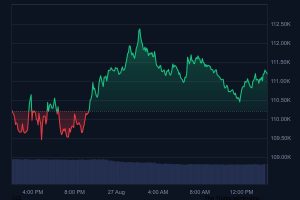
This decline aligns with Bitcoin’s recent pullback. The coin is currently trading at $111,300, up 2.52% from Monday’s low of $108,550 but still more than 10% below its August 14 peak of $124,128.
Institutional Outflows Add to Pressure
Weaker on-chain momentum isn’t the only challenge facing Bitcoin. Spot Bitcoin ETFs have recorded persistent outflows, signaling cooling institutional demand and amplifying macro-driven selling pressure.
Ecoinometrics, a crypto macro research newsletter, noted that as of last Friday, its flows-to-price model projected Bitcoin at $107,000, with risks of dipping below the critical $100,000 psychological level if ETF outflows persist.
Georgii Verbitskii, a derivatives trader and founder of DeFi platform TYMIO, echoed this cautious outlook. “It looks like we’re entering a cooling-off phase that could last through September,” he told a leading crypto news outlet, adding that $100,000 remains “on the table” despite his long-term bullish bias.
Long-Term Holders Taking Profits
Another factor adding to bearish pressure is profit-taking from long-term holders. Glassnode reported that realized profits from this cohort are the second largest compared to previous market cycles, a strong signal that the market may be entering a late-stage phase of its rally.
Such selling often precedes periods of consolidation or correction, as early investors lock in gains and new buyers hesitate at higher valuations.
Historical Headwinds in September
Seasonality also works against Bitcoin this month. Data from CoinGlass shows that September has delivered an average return of -3.77% over the past 12 years, making it one of the weakest months for BTC. Similarly, the third quarter has historically skewed negative, compounding cautious sentiment among traders.
Verbitskii cautioned against rushing into new bullish bets: “Long positions only make sense if we reclaim and hold above $118,000. Otherwise, a wait-and-see approach is safer in this environment.”
While Bitcoin’s bounce this week has offered temporary relief, analysts warn that slowing fundamentals and institutional outflows point to a more subdued September. With the possibility of testing $100,000 support, investors may need to brace for volatility and avoid overextending long positions until momentum strengthens.
For now, Bitcoin’s September forecast remains one of caution, a cooling phase that could define its short-term path even as long-term bullish sentiment stays intact.



