






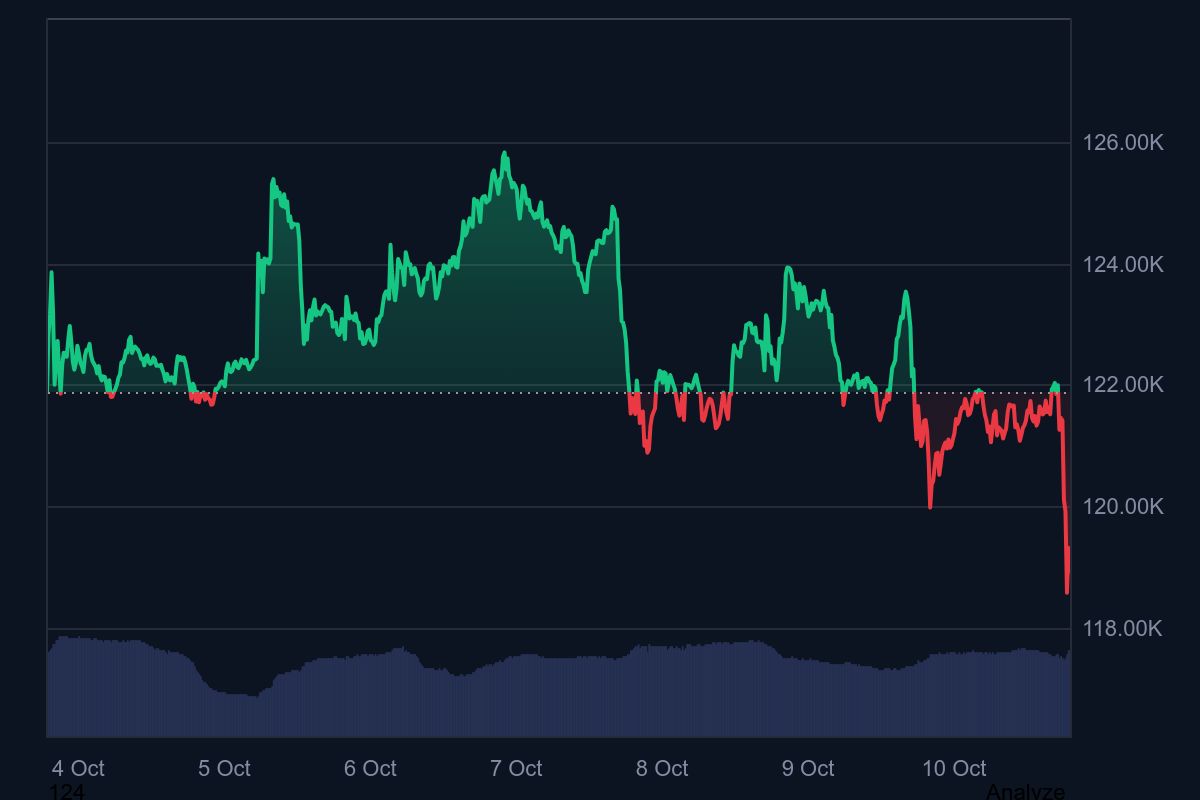
Bitcoin (BTC) slipped under the $119,000 mark today, mirroring a global sell-off triggered by rising geopolitical tension and profit-taking across risk markets.
The decline followed President Donald Trump’s statement that the U.S. may impose a “massive increase” in tariffs on Chinese imports after Beijing announced export restrictions on rare earth elements, a move that immediately shook global equity and crypto markets. The threat of a renewed U.S.–China trade war has reignited risk aversion, pushing investors toward safe havens like gold and U.S. treasuries.
Traditional markets reflected the impact: the S&P 500 fell 1.5% and the Nasdaq dropped 1.77%, while gold climbed 1% to $4,000/oz. Bitcoin, often seen as a high-beta asset, was caught in the crossfire, declining 2.13% over the past 24 hours to $118,764, while its seven-day loss widened to 3.28%. Despite the sell-off, 24-hour trading volume jumped 12.3% to $75.1 billion, showing elevated volatility as traders repositioned amid macro uncertainty.
Geopolitical Tension Meets Technical Breakdown
From a technical standpoint, Bitcoin broke below its 7-day SMA ($122,781) and the 23.6% Fibonacci retracement level ($122,071), erasing gains from its October 6 peak of $126,198. The move invalidated the previous short-term bullish structure, though momentum remains mixed – the RSI sits near 59, indicating neutral strength, while the MACD histogram (+708) stays slightly positive. Analysts note that a retest of the 38.2% Fibonacci level ($119,518) is likely in the near term.
What Comes Next
Market watchers say Bitcoin needs to close above $122,000 to regain a bullish bias. Failure to do so could open the door for a deeper correction toward $115,000, aligning with the 50% Fibonacci retracement zone. Until trade rhetoric cools and liquidity stabilizes, BTC may continue to trade defensively – with macro headlines, not technicals, steering short-term price action.



