






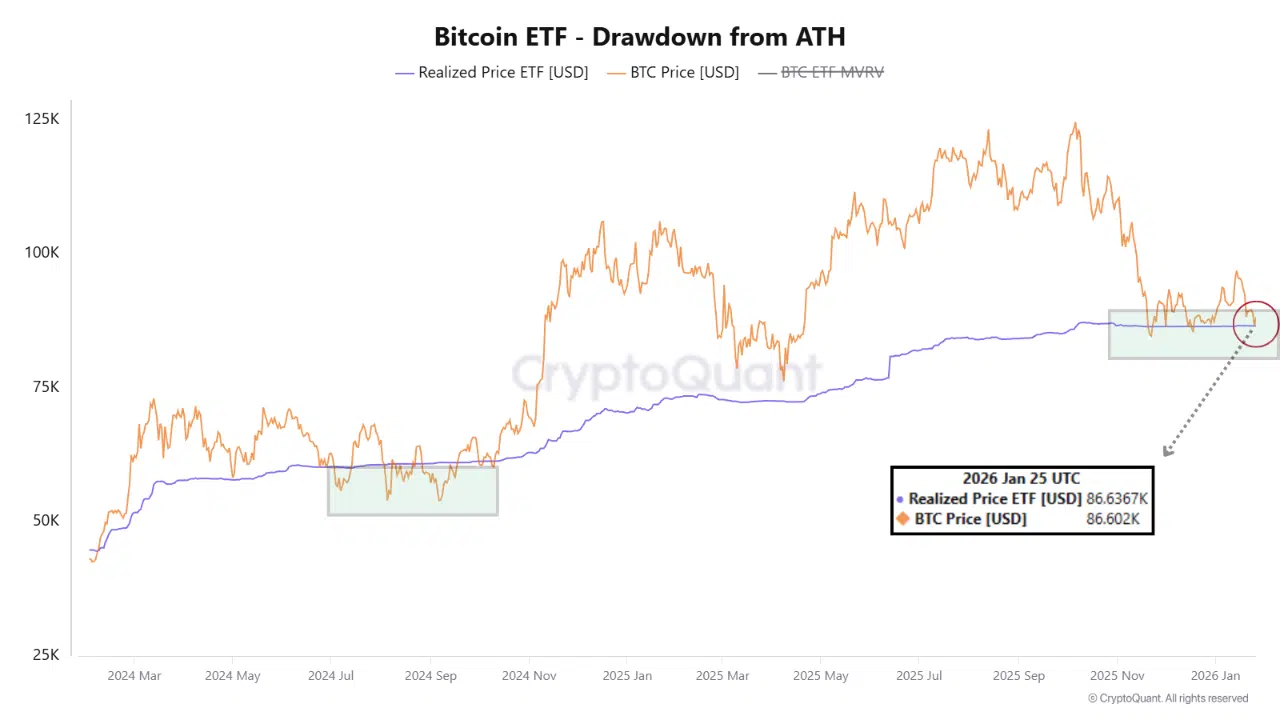
Bitcoin is trading near $87,000, a level that aligns almost precisely with the realized price of Bitcoin ETF holders at roughly $86,600, according to a report shared by CryptoQuant.
This convergence places the market at a critical behavioral threshold, where the average ETF investor has effectively returned to breakeven after months of volatility.
Rather than signaling trend direction, this zone highlights a shift in investor psychology. With price sitting on realized cost, ETF holders are no longer deciding whether to take profits, but whether to tolerate further drawdowns or exit positions without loss. Historically, this type of level tends to act as a pivot for flows rather than price alone.
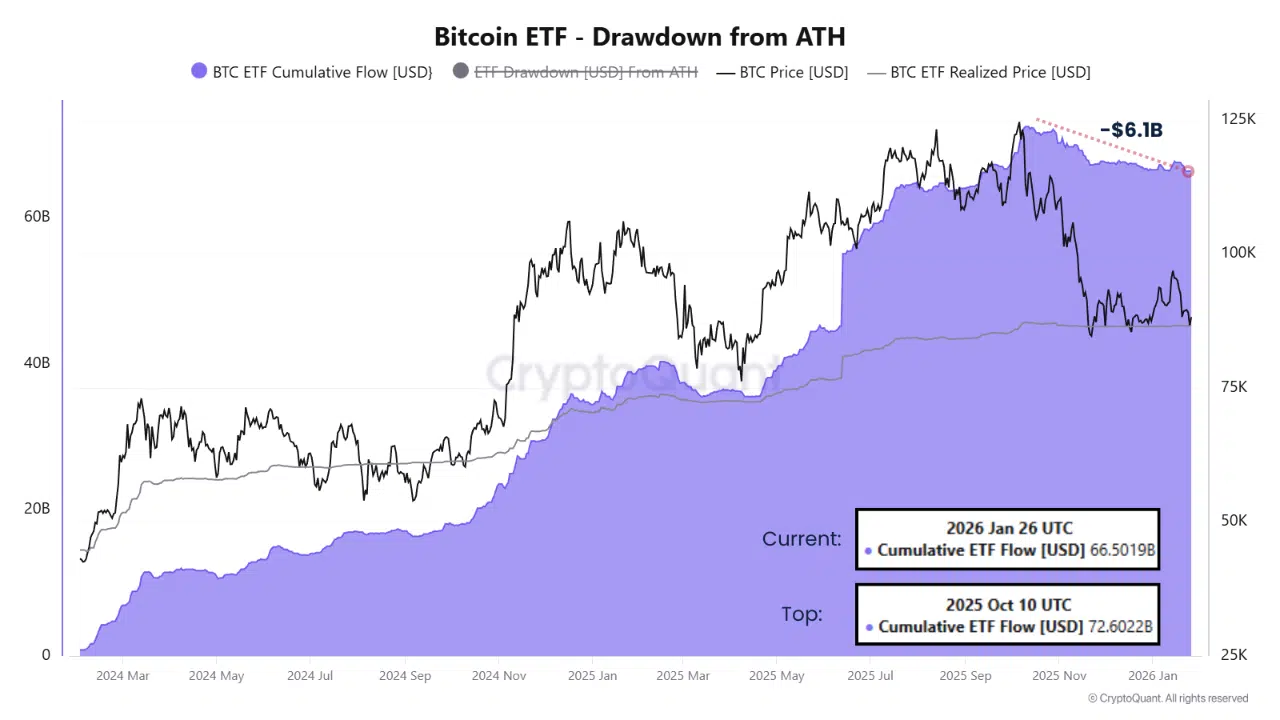 Short-Term Price Action Centers on ETF Cost Basis
At current levels, Bitcoin is consolidating directly on top of the ETF cohort’s realized price. Structurally, this removes the profit cushion that previously reduced selling pressure. As long as price remains above $86,600, ETF holders retain an incentive to stay invested, reinforcing flow stabilization rather than forced exits.
A sustained move below $86,600 would change that dynamic. Trading under realized price typically shifts behavior from passive holding into active distribution, as breakeven turns into unrealized loss. In that scenario, redemptions often accelerate, not because of technical breakdowns, but due to declining tolerance for drawdowns.
The market is therefore less focused on momentum and more on acceptance. Price is not reacting violently, but hovering at a level where decisions are being made incrementally.
ETF Flows Show Pressure Without Capitulation
Flow data underscores this tension. Bitcoin ETFs reached a cumulative flow peak of approximately $72.6 billion on October 10, 2025. Since then, around $6.1 billion has exited these products, reducing total holdings to roughly $66.5 billion, an 8.4% drawdown from the peak.
What stands out is that despite this meaningful outflow, the ETF realized price has remained relatively stable and continues to trend higher. This suggests that a portion of selling has come from less committed capital, likely late-cycle entrants or tactical traders exiting as profit margins narrowed.
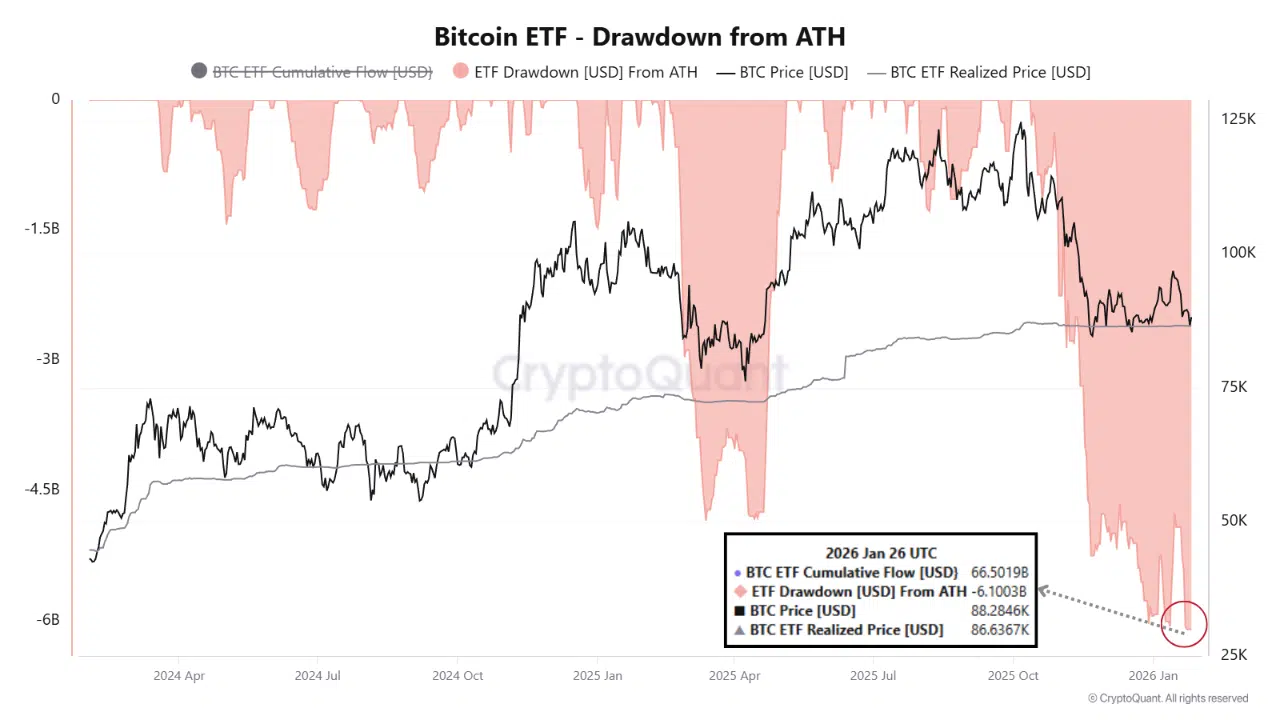
In effect, ETF investors have already absorbed substantial pressure without triggering a collapse in cost basis. This makes the current level more about endurance than panic.
Scenarios and Risk Around the Realized Price
- Stabilization scenario
If Bitcoin continues to hold above $86,600, ETF holders retain a psychological anchor. This supports consolidation and reduces the likelihood of accelerating redemptions, even if upside momentum remains limited in the near term. - Distribution risk scenario
A sustained move below $86,600 would place the average ETF investor into unrealized loss. Historically, this increases sensitivity to downside and can shift flows from gradual outflows into more aggressive redemptions, amplifying pressure independent of broader market structure.
Professional Takeaway
This level is not about confirming a new trend or calling a reversal. It represents a behavioral stress test for a relatively new investor cohort. Bitcoin is trading at the point where ETF conviction is actively evaluated rather than assumed.
As long as price holds above the ETF realized price, investors have a rational reason to remain patient. Failure to do so risks transforming consolidation into distribution, driven not by leverage or technical breaks, but by psychology and tolerance for drawdowns.



