



According to a report shared by CryptoQuant, Bitcoin has just recorded $2.3 billion in realized losses (7-day average), one of the largest capitulation events in its history.
This level of losses puts the current drop alongside major crashes such as 2021, the 2022 Luna/FTX collapse, and the mid-2024 correction.
What Does “Realized Loss” Mean?
The Net Realized Profit/Loss metric tracks how much money investors actually lock in when they move or sell Bitcoin on-chain.
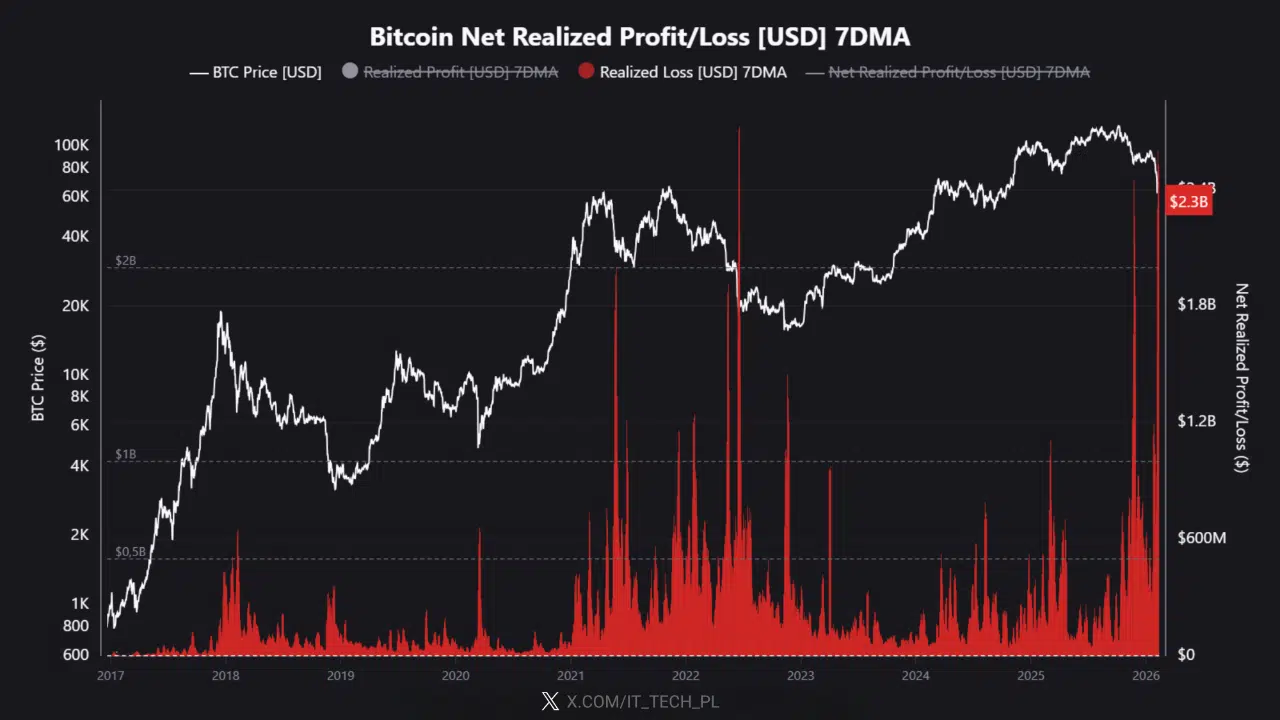
When the number turns deeply negative, it means many holders are selling at a loss.
A reading of $2.3B means billions of dollars’ worth of Bitcoin was sold below purchase price. That reflects panic and forced exits.
Who Is Selling?
The data shows that Short-Term Holders, those who bought in the last few months, are driving the losses.
Many entered between higher levels and are now exiting under pressure. This is typical during sharp corrections.
Long-Term Holders, on the other hand, are largely holding their positions. They are not contributing significantly to the loss spike.
What Usually Happens After Events Like This?
Historically, extreme loss spikes often happen near local bottoms. After this capitulation event, Bitcoin bounced from around $60,000 to $71,000.
However, relief rallies can occur even during broader downtrends. A bounce does not automatically mean a full recovery.
The Bottom Line
This $2.3B loss event shows intense short-term fear and forced selling. The market has clearly flushed out weaker hands.
Whether this becomes a lasting bottom or just a temporary rebound will depend on sustained demand returning to the market.