





The projected $646 billion AI spending pipeline for 2026 is colliding with weakening balance-sheet flexibility across major technology firms.
That capital intensity shift is altering how institutional capital interprets both Big Tech and Bitcoin.
According to analysis shared by CryptoQuant, Bitcoin is no longer behaving as a decorrelated hedge. Instead, it increasingly functions as a real-time gauge of institutional risk appetite, particularly through ETF positioning flows.
The End of the “Safe” Big Tech Regime
The narrative of mega-cap technology companies as defensive, cash-generating anchors is fading. Companies including Alphabet Inc. are reportedly pursuing century-long debt structures, 100-year pound-denominated issuance, to sustain competitive positioning in the AI arms race.
Meanwhile, projected combined AI investment from firms such as Meta Platforms, Microsoft, Amazon, and Alphabet is estimated at $646 billion in 2026.
This scale of capital expenditure compresses margins and elevates leverage, fundamentally changing institutional risk calibration. Bitcoin’s ETF flows have mirrored that adjustment.
ETF Flows Reflect Institutional Pressure
Since the October 2025 peak, ETFs have recorded approximately 100,000 BTC in net outflows. The average realized entry price for ETF participants sits near $90,000, placing many allocations under stress during corrective phases.
CryptoQuant frames this environment through the Institutional Survival Index (ISI), currently reading -0.30%, placing Bitcoin at what it defines as Critical Support.
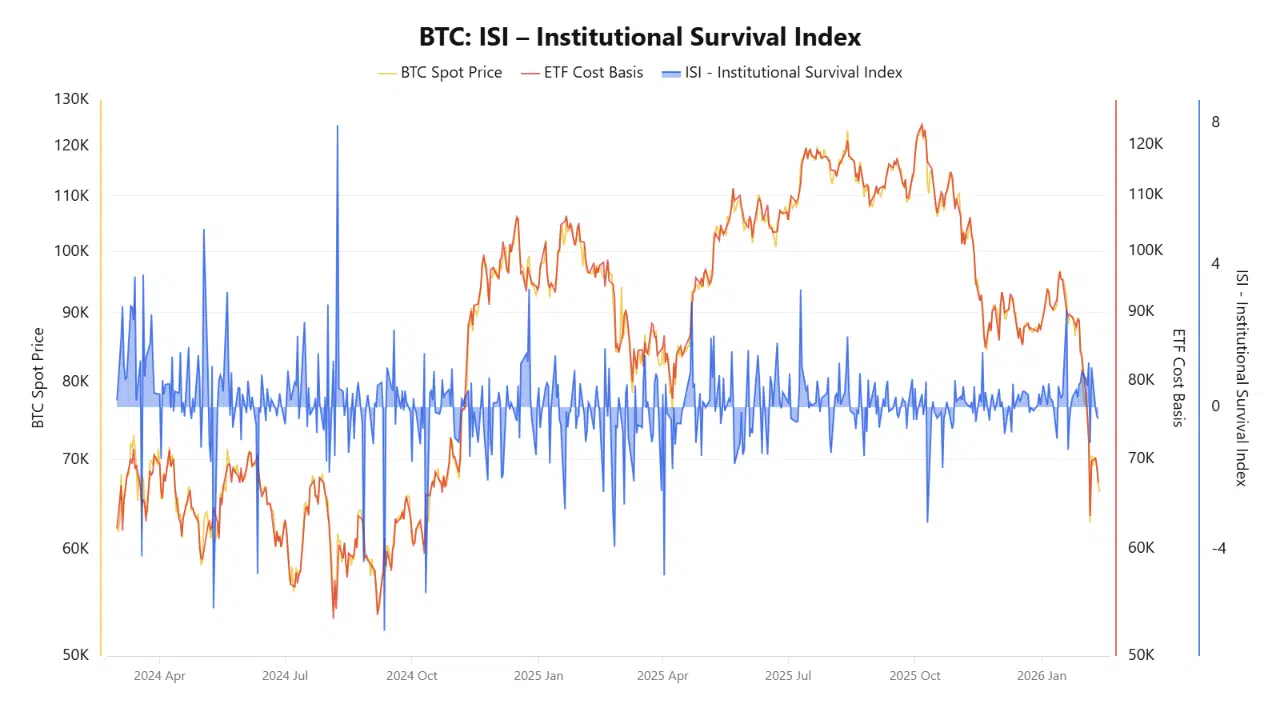
The framework segments risk into three zones:
- ISI > 0% → Profit Zone (validated safe haven)
- ISI 0% to -5% → Stress Zone (support under macro pressure)
- ISI < -5% → Danger Zone (capitulation and forced liquidation)
With ISI hovering slightly negative, ETF positioning remains in a fragile equilibrium.
Price Thresholds and Institutional Cost Basis
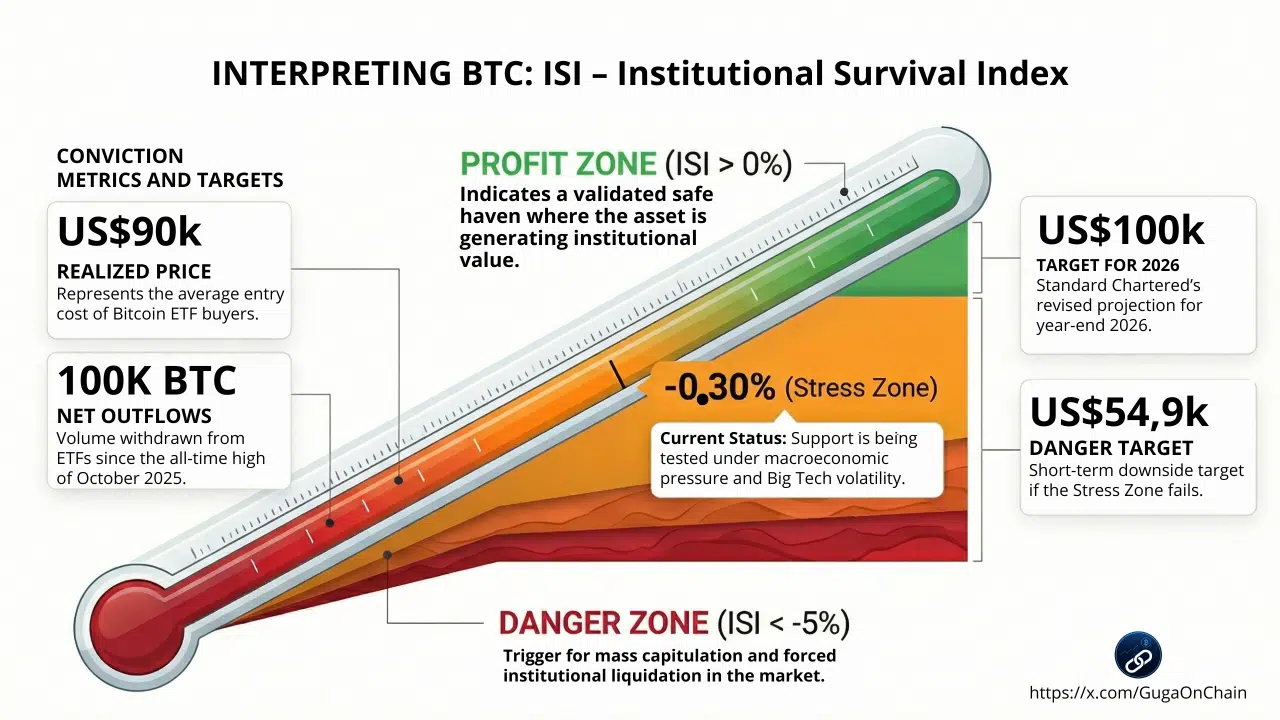
Two levels frame the short-term structural outlook:
- $54,954 → Identified as a “Danger” target under continued pressure.
- $100,000 → Revised end-of-2026 projection by Standard Chartered.
The technical nuance of the ISI lies in its methodology: it compares real-time spot pricing with institutional cost basis, adjusted for T+2 ETF settlement lag. This delay creates friction between perceived performance and actual capital stress.
If ETF margins remain negative for an extended period, institutional tolerance thresholds could narrow further.
Structural Regime Shift
Bitcoin’s behavior in this cycle suggests less independence from macro technology stress and greater sensitivity to institutional positioning flows. Where Big Tech once represented defensive ballast, aggressive AI spending and long-duration debt issuance now introduce balance-sheet strain.
Under this regime, Bitcoin is not merely reacting to its own internal cycle dynamics. It is responding to institutional survival math.
Whether the ISI stabilizes above deeper stress thresholds will determine if this phase represents consolidation ahead of recovery or a precursor to forced de-risking.
For now, the structure signals stress containment, not confirmation of renewed strength.



