


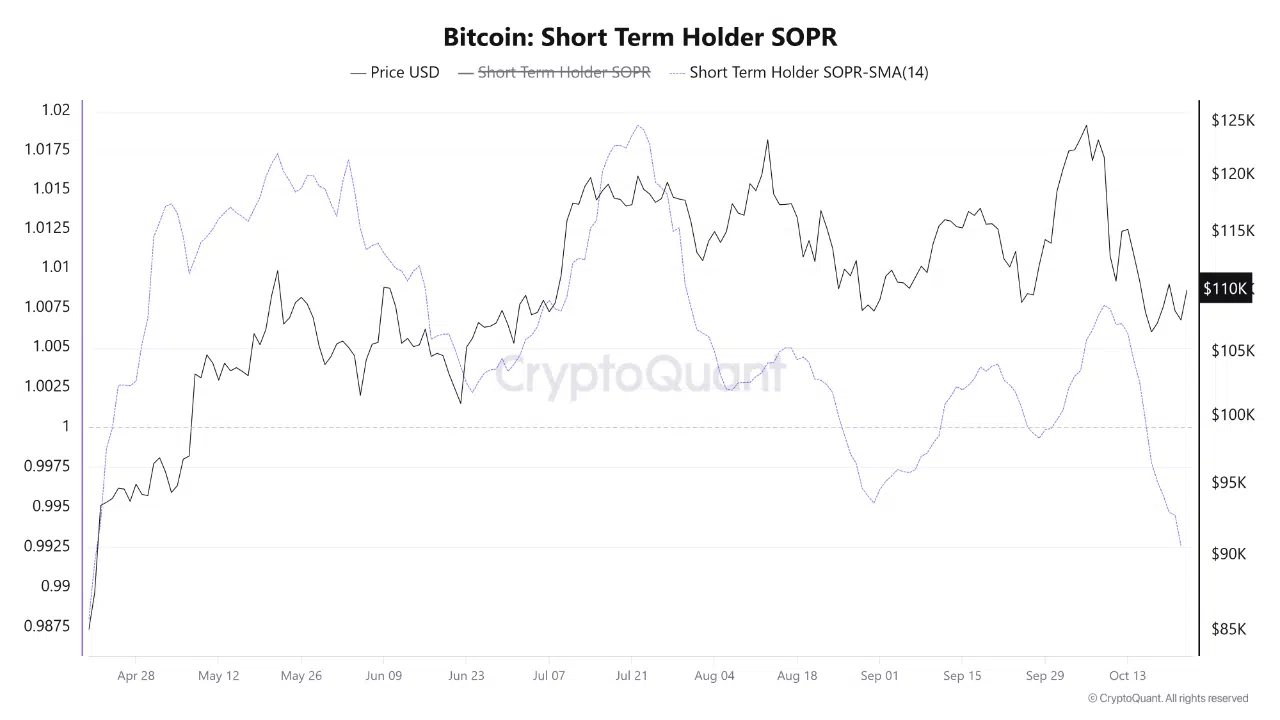
According to the latest CryptoQuant data released on October 23, Bitcoin’s short-term holders (STH) are now selling at a loss for the first time in six months, a pattern often linked to late-stage corrections and potential bottom formation.
The Short-Term Holder Spent Output Profit Ratio (STH-SOPR) has dropped to 0.992, its lowest reading since April. This metric tracks the average realized profit or loss of coins held for less than 155 days. A value below 1.0 indicates that these traders are selling their Bitcoin below their cost basis, effectively capitulating.
At 0.992, the data shows that short-term holders are realizing losses of about 0.8% per sale, signaling growing panic among retail participants. “This type of capitulation typically reflects fear and exhaustion among newer entrants,” the CryptoQuant report explains.
While the near-term signal remains bearish, analysts note that such selloffs historically precede recovery phases. “Every major bottom in the past three years has coincided with short-term holder losses,” the report adds.
The Contrarian Setup: Weak Hands Out, Strong Hands In
When the STH-SOPR dips below 1.0, the market tends to enter a “cleansing phase,” where emotional traders exit while long-term investors and institutional players accumulate at discounted prices.
CryptoQuant’s data also shows that Bitcoin’s 14-day moving average of SOPR remains under the same threshold, confirming that short-term losses are sustained rather than momentary. This phase often builds the foundation for the next upward cycle, as “weak hands” capitulate and liquidity rotates to patient, long-term holders, typically known as whales.
Still, analysts caution that a decisive move back above 1.0 will be necessary to confirm a shift from fear-driven selling to recovery momentum. Until that happens, rallies may face resistance as traders who bought higher attempt to exit near breakeven.
Merlijn the Trader: “The Old Bitcoin Cycle Is Dead”
Amid this wave of short-term capitulation, market analyst Merlijn The Trader shared a striking new perspective on Bitcoin’s long-term rhythm. In a post to X on October 23, he declared, “The old Bitcoin cycle is dead.”
THE OLD BITCOIN CYCLE IS DEAD.
The 1064/364 rhythm defined every cycle.
Until now.This time the Fed just flipped.
Monetary easing just returned.
And liquidity is the new driver.Forget the clock.
This is about capital velocity. pic.twitter.com/RwKEZGj9Gg— Merlijn The Trader (@MerlijnTrader) October 23, 2025
Historically, Bitcoin followed a 1064/364-day rhythm, roughly three years of accumulation followed by one year of correction. But according to Merlijn, the landscape has shifted dramatically. “This time the Fed just flipped. Monetary easing just returned. And liquidity is the new driver,” he wrote, suggesting that macroeconomic policy, not time-based halving cycles, will define Bitcoin’s future trajectory.
His chart illustrates how past cycles adhered to that 1064/364 rhythm, but the current expansion phase appears to be breaking from that pattern entirely. In Merlijn’s view, this cycle is no longer dictated by halving timelines or rigid historical symmetry. Instead, he argues, “Forget the clock. This is about capital velocity.”
Liquidity Replaces Time as Bitcoin’s New Cycle Driver
The convergence of these narratives, retail capitulation and renewed liquidity, paints a complex but potentially bullish picture for Bitcoin. While short-term traders sell in fear, long-term accumulators may already be positioning for the next macro-driven leg higher.
If Merlijn’s liquidity thesis holds true, Bitcoin’s rhythm could now be tied to Federal Reserve policy shifts and global monetary flows rather than the rigid halving framework that shaped previous cycles.
For now, CryptoQuant’s data shows stress in the short term, but history suggests that deep retail capitulation often sets the stage for recovery. As liquidity returns and institutional confidence builds, Bitcoin’s next move may not follow the old script, but it could still rhyme.