





Bitcoin has entered its fourth consecutive red monthly candle, and according to analyst EGRAG Crypto, history suggests this is part of a structured sequence, not random price action.
The core argument centers on historical monthly patterns across prior cycles. Rather than bottoming immediately after sharp declines, Bitcoin typically moves through a process of compression, liquidity flushes, and temporary relief rallies before printing a final cycle low.
What Past Cycles Show
Looking back at previous macro cycles:
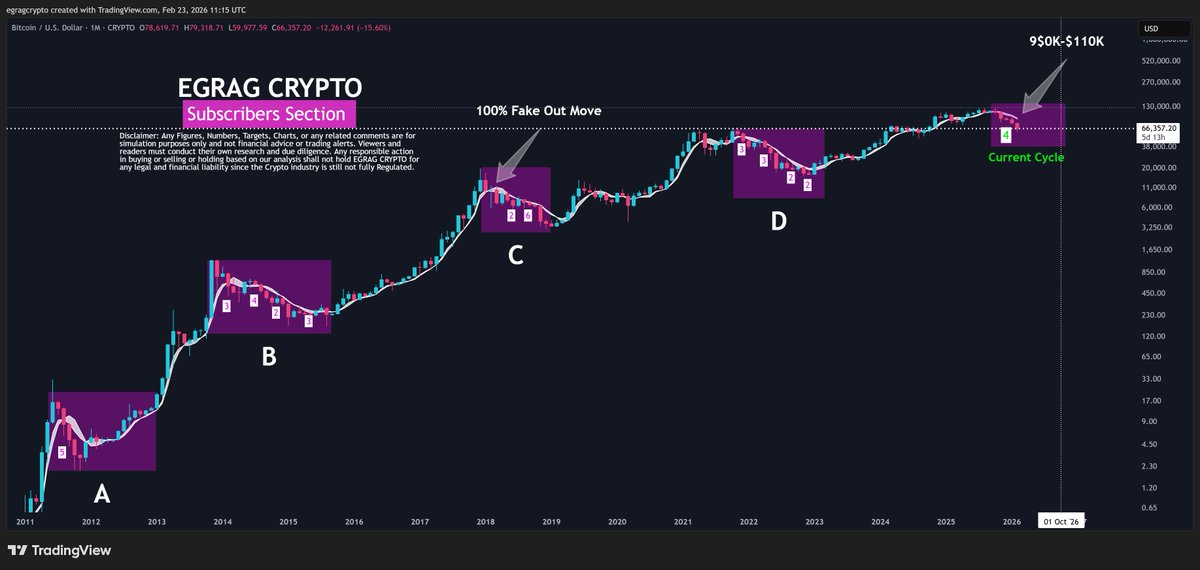
- Cycle A ended with five consecutive red months before a confirmed bottom.
- Cycle B formed clusters of 3 → 4 → 2 → 3 red months. Each cluster produced a relief bounce, except the final one, which marked the cycle bottom.
- Cycle C printed two red months followed by relief, then six red months before the ultimate bottom formed.
- Cycle D showed 3 → 3 → 2 → 2 red months, eventually confirming a bottom.
The consistent theme across cycles is sequencing. Bitcoin rarely bottoms instantly after the first wave of downside. Instead, it compresses, flushes liquidity, bounces, and only then prints the final low.
Current Structure: Where We Stand Now
In the current cycle:
- Bitcoin is approaching its fourth consecutive red monthly candle.
- No meaningful relief bounce has occurred yet.
- The structure resembles a pre-relief compression phase, not a confirmed bottom.
That absence of relief is key. Historically, relief rallies tend to appear before the final bottom, not after it.
Most Probable Path Forward
Base Case (Highest Probability)
The fourth red month completes.
A short relief bounce follows — possibly a reset rally or dead-cat bounce.
Then one final red leg (a fifth or even sixth red month) forms the true bottom.
This mirrors behavior seen in Cycles A and C.
Alternative Case
A relief bounce arrives immediately after the fourth red month.
However, the bottom remains unconfirmed.
The market later revisits or slightly undercuts prior lows.
Least Likely Scenario
An immediate V-shaped reversal with no additional red monthly candles.
Historically, monthly Bitcoin structures rarely resolve with sharp V recoveries.
What This Phase Represents
This stage reflects capitulation compression rather than expansion.
The absence of relief suggests pressure is still building beneath the surface.
In prior cycles, relief rallies typically appear before the final bottom forms, not after euphoric strength returns.
Bottom Line
Four red monthly candles historically signal late-stage downside, but not necessarily completion.
If historical sequencing holds, a relief bounce is likely next.
The final cycle bottom, however, typically prints after that bounce, not before it.



