


Bitcoin extended its decline early Tuesday, falling to $103,990, down 3% in the past 24 hours, after a sharp sell-off wiped out earlier stability. The drop followed a liquidation-driven downturn, with sentiment weakening ahead of key U.S. inflation data due later this month.
Macroeconomic Caution Returns
Bitcoin’s pullback comes as traders adopt a cautious stance following the Federal Reserve’s late-October rate cut, which provided only brief relief. Instead of fueling optimism, investors are now questioning whether further monetary easing will materialize in early 2026.
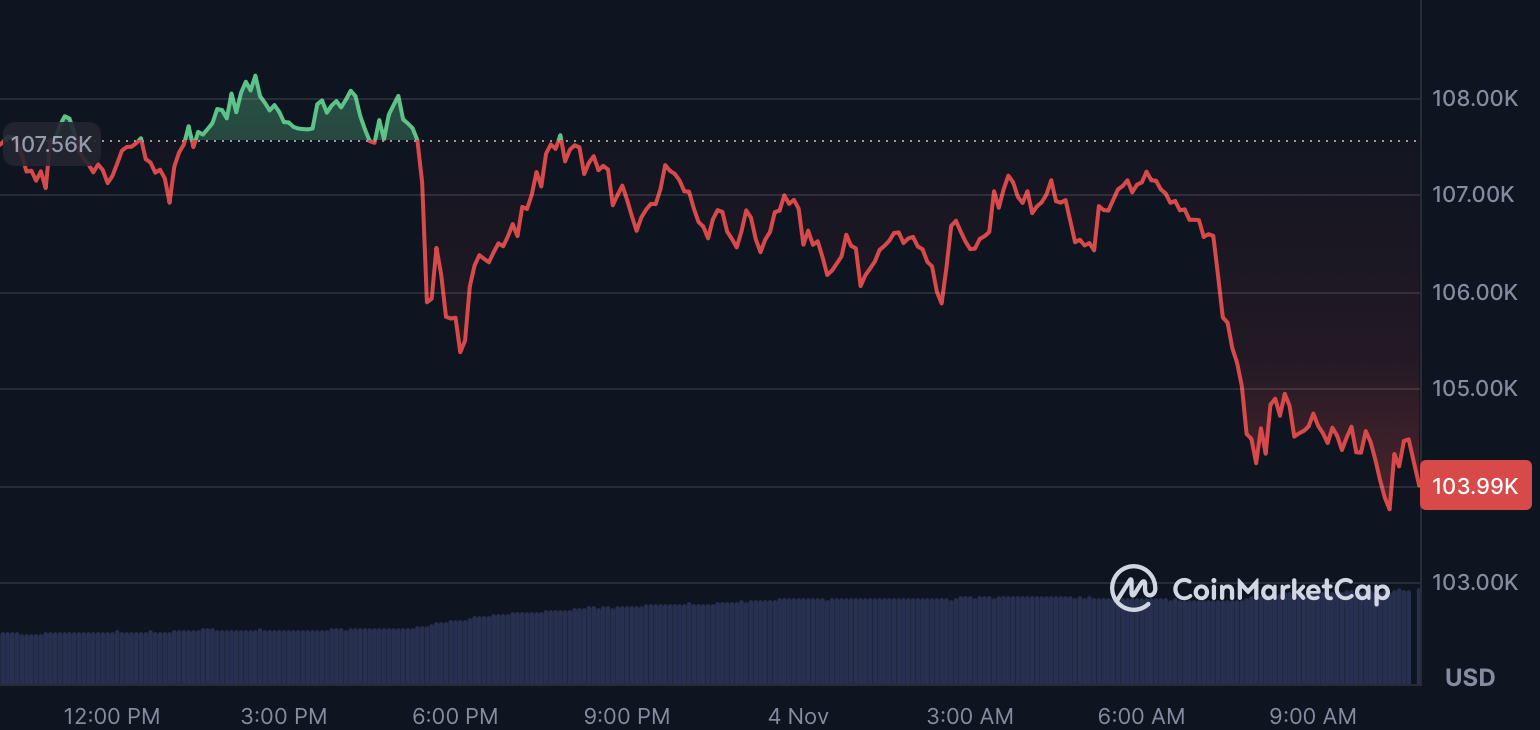
Analysts note that market participants are shifting to a “wait-and-see” mode, monitoring how inflation data will shape the Fed’s next policy move. The strong U.S. dollar and muted liquidity during Asian and early European hours have amplified Bitcoin’s volatility, making it more sensitive to even moderate sell orders.
The broader risk environment has also turned defensive. With global equities wobbling and Treasury yields edging higher, institutional investors are de-risking portfolios, reducing exposure to Bitcoin and other volatile assets in favor of gold and cash holdings.
Technical Pressure Mounts
On the technical front, Bitcoin’s decline accelerated after breaking below its short-term moving averages, triggering algorithmic selling. The price has struggled to reclaim intraday highs, confirming bearish momentum on both hourly and daily charts.
Technical indicators show the MACD lines crossing downward, while momentum oscillators lean negative, both classic warning signals of short-term weakness. Analysts also identify a developing head-and-shoulders pattern, suggesting a continuation of the downtrend toward the next key support zone around $100,355.
Market Outlook
Trading volume has surged 83% in the past 24 hours to $80.3 billion, indicating heightened volatility rather than renewed buying interest. Market watchers expect Bitcoin to remain range-bound between $100K and $107K until macroeconomic clarity emerges.
With 19.94 million BTC in circulation and market capitalization now at $2.07 trillion, Bitcoin remains resilient on a long-term horizon, but near-term pressure is likely to persist as traders navigate thin liquidity, tightening financial conditions, and rising caution ahead of the mid-November CPI release.