





Bitcoin exchange reserves have dropped to their lowest level on record, but underlying liquidity data suggests the outlook may not be entirely bullish.
Exchange Supply Shrinks to Historic Levels
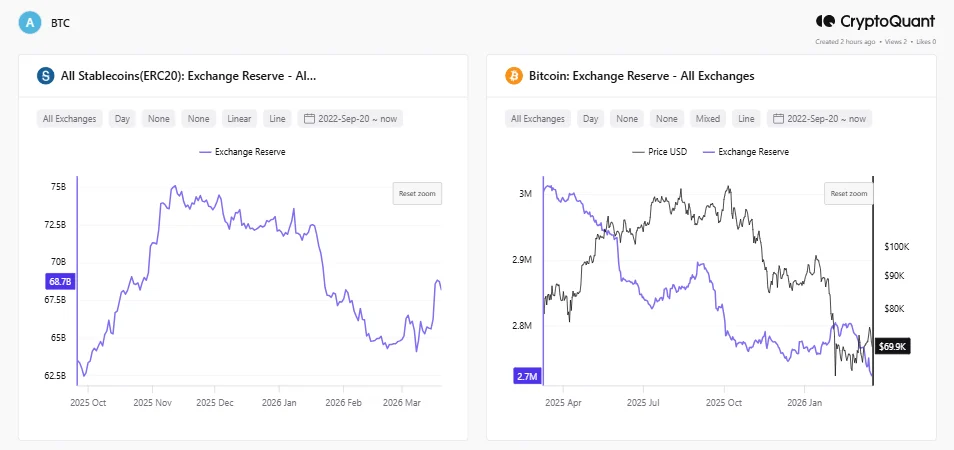
The total amount of Bitcoin held on exchanges has fallen to approximately 2.72 million BTC, marking an all-time low.
This decline came during a period of intensified selling pressure that pushed prices lower between mid-week sessions. Typically, falling exchange reserves are viewed as bullish, since fewer coins are readily available for selling.
However, this time the broader context complicates that narrative.
Stablecoin Liquidity Raises Red Flags
While Bitcoin reserves were declining, stablecoin reserves also dropped sharply, signaling that liquidity may be leaving the market rather than rotating into BTC.
As of March 18:
- Stablecoin reserves stood at $68,839,858
- They fell to $68,203,364 within 48 hours
- This represents a withdrawal of over $600,000
This type of rapid outflow has historically preceded periods of reduced buying pressure.
Earlier patterns show similar behavior between January 18 and January 21, which was followed by a broader liquidity pullback across the market.
Liquidity vs Price Action Divergence
The data reveals a key divergence:
- Rising liquidity previously supported buying even during price declines
- Current conditions show liquidity fading alongside price weakness
This shift suggests that buyers are becoming less aggressive, and capital is not immediately redeploying into the market.
Not All Supply Shocks Are Bullish
Although declining exchange reserves often point to accumulation, they can also reflect capital exiting the market entirely.
In this case, the simultaneous drop in stablecoin reserves indicates that:
- Funds are not staying within the crypto ecosystem
- Market participants may be reducing exposure
- Short-term demand could weaken further
Downside Risk Remains in Play
If the current trend continues, Bitcoin could face additional downside pressure in the near term.
The key factor to watch is whether liquidity returns. Without fresh capital entering the market, reduced exchange supply alone may not be enough to sustain upward momentum.
For now, the data suggests a more cautious outlook, where shrinking supply is being offset by declining demand.



