





Fresh analysis from Cointelegraph Research and Rena Labs has revealed new details about the October 10 crypto market crash, now confirmed as one of the largest liquidation events in digital asset history, wiping out more than $19 billion in leveraged positions across major exchanges.
According to the report, the crisis was triggered when Binance’s internal pricing mechanism for key collateral assets, including USDE, bnSOL, and wBETH, failed to reflect accurate external market values. Instead of relying on oracle-based pricing feeds, the exchange used its own internal valuations, creating a severe mispricing event that rippled across derivatives markets.
How the Collapse Unfolded According to the Report
Orderbook data from Rena Labs shows a 97% loss of market depth in the USDE/USDT trading pair, sparking a chain reaction of forced liquidations. The stablecoin’s price fell to $0.68, breaking its dollar peg and triggering a “liquidation cascade” as traders’ margin positions evaporated within minutes.
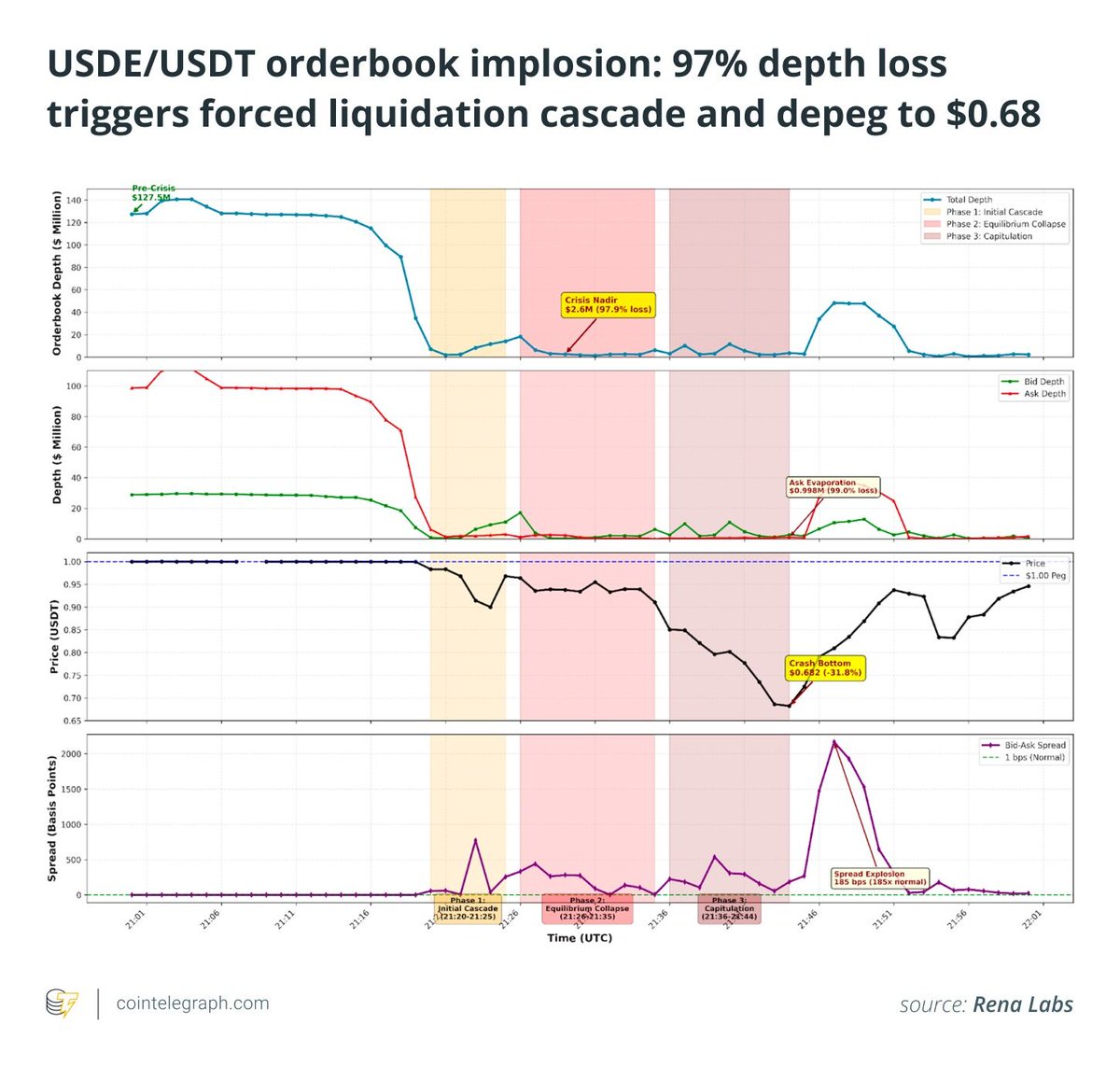
The report identifies four distinct stages of the meltdown, initial liquidity loss, equilibrium collapse, liquidation cascade, and capitulation. By the time the dust settled, both long and short positions had been flushed out, with cascading liquidations amplifying volatility across altcoin markets.
Systemic Risk Concerns
Researchers warn that Binance’s decision to depend on internal pricing rather than external oracles created a feedback loop of inaccurate collateral valuation. This failure, they argue, undermines the credibility of the exchange’s risk management system and exposes broader vulnerabilities in synthetic dollar and wrapped-asset markets.
“Had Binance used external oracle validation, the scale of the depeg and forced liquidations could have been significantly reduced,” the report noted.
Aftermath and Industry Impact
The event has already sparked renewed debate among institutional traders and regulators about exchange transparency and the resilience of synthetic assets. Analysts believe the collapse will accelerate calls for independent price feeds and stricter governance for stablecoin-backed collateral systems.
While liquidity has since returned to normal levels, the October 10 implosion is being described as a turning point, a stark reminder that even the world’s largest exchange remains susceptible to structural failures when internal controls override market transparency.



