





Binance reduced its direct exposure to the four largest Iranian cryptocurrency exchanges by more than 97.3% between January 2024 and January 2026, according to a recent company statement.
The exchange reports that exposure declined from approximately $4.19 million in early 2024 to around $0.11 million by January 2026, marking a substantial contraction over a two-year period.
Exposure Reduced From $4.19M to $0.11M
The accompanying chart shows Binance’s direct exposure steadily decreasing across 2024 and 2025. By early 2025, exposure had already fallen to roughly $0.39 million, before declining further to $0.11 million at the start of 2026.
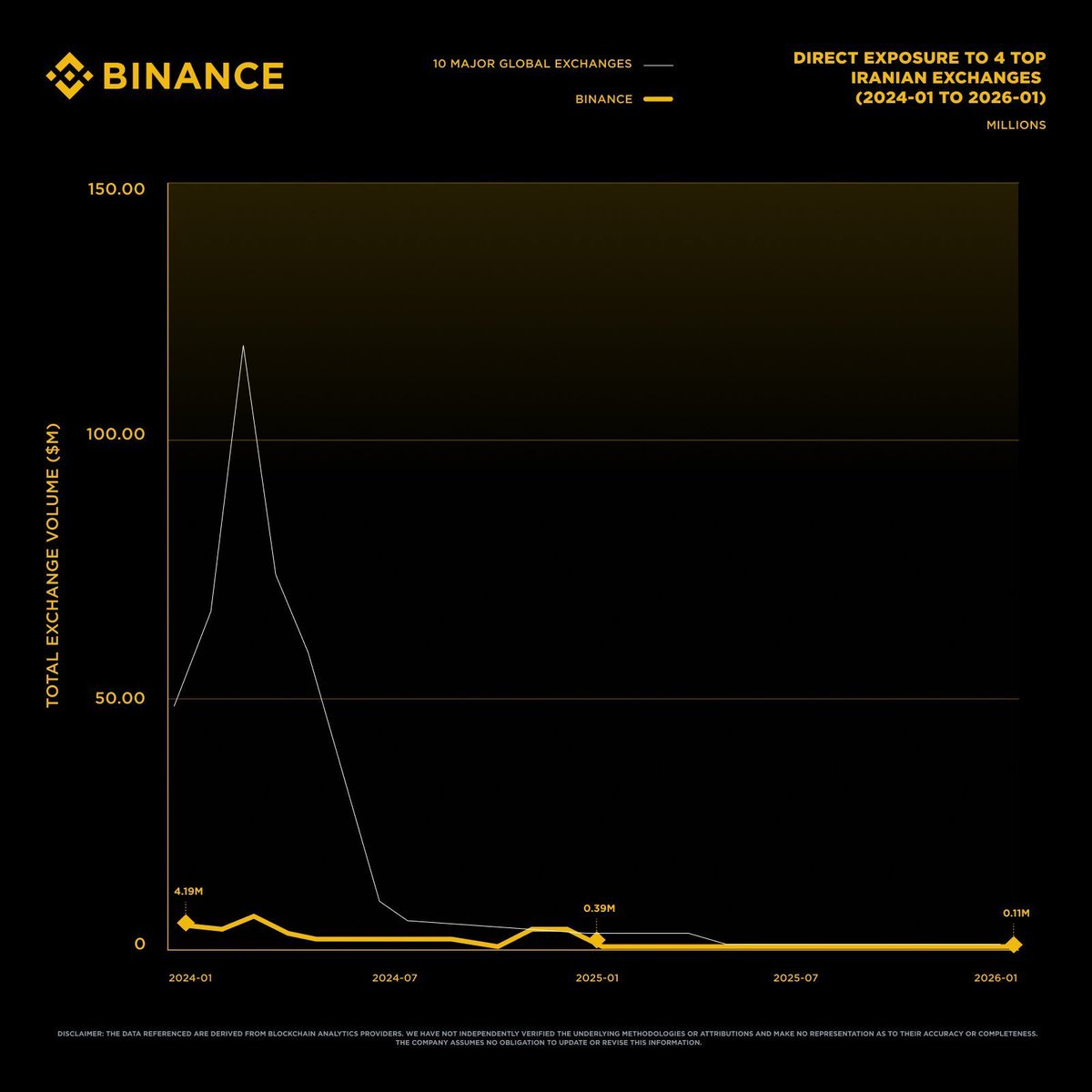
The data compares Binance’s exposure management with that of 10 major global exchange peers. According to the statement, Binance outperformed those peers in reducing direct exposure to the four Iranian platforms.
Operational Constraints on Public Blockchains
Binance also emphasized a structural limitation of blockchain infrastructure: public networks are permissionless. Any user can send digital assets to an exchange deposit address without prior authorization.
As a result, exposure cannot be reduced to absolute zero. The company stated that what matters operationally is monitoring, mitigation, and reporting, areas in which it claims to have implemented controls.
Risk Management in a Permissionless Environment
The development highlights the broader compliance challenge facing global crypto exchanges. Unlike traditional financial rails, blockchain transactions are not pre-screened before being sent.
This means exchanges must rely on:
- Transaction monitoring systems
- Risk scoring frameworks
- Internal compliance controls
- Ongoing reporting and mitigation processes
The reduction from $4.19 million to $0.11 million suggests active management rather than passive exposure.
A Compliance-Focused Update
While the absolute dollar amounts are relatively small compared to Binance’s global volumes, the percentage reduction underscores the exchange’s attempt to tighten exposure in sensitive jurisdictions.
The announcement frames the change as part of a broader compliance and risk management strategy, acknowledging that while exposure cannot be fully eliminated in a permissionless system, it can be significantly reduced through oversight and operational controls.



