



- Bill Morgan argues stablecoins require counterparties, allow expandable supply, and track inflationary fiat, while XRP enables cross-border settlement.
- Stablecoins suit collateral but not inflation hedging; David Schwartz says XRP carries bridge volume within Ripple Payments today.
Industry debate around stablecoins and bridge assets is intensifying. Attorney Bill Morgan argues that instruments like RLUSD and USDT carry constraints that limit their role beyond payments convenience.
He notes three core issues: a required issuer or custodian, an expandable supply that can be minted on demand, and linkage to fiat currencies that lose purchasing power over time. In that context, he frames XRP as a neutral bridge that can move value across borders without tying outcomes to any single currency regime.
Treasury use sits at the center of the argument. Stablecoins track the dollar and therefore do not hedge inflation; they aim to reduce volatility, not preserve real value. Morgan contends that cross-border settlement needs an asset that is fast, decentralized, and not dependent on a redeeming party.
Stablecoins such as RLUSD and USDT have several disadvantages compared to a bridge currency such as XRP:
1. There is a counterparty.
2. No one mentions it, but they are not finite. Tether for example is minted at will;
3. They are tied to fiat such as the USD. That is hardly a…— bill morgan (@Belisarius2020) August 30, 2025
Ripple’s CTO, David Schwartz, has made a similar case, saying XRP carries the bulk of bridge volume within Ripple Payments. The view is straightforward: use stablecoins as working collateral where needed, but rely on a neutral bridge for final settlement between currencies.
Paradoxically, stablecoin growth may still help bridge assets. As adoption expands, more payment endpoints appear, which can raise the utility of a chain’s native bridge currency. Analyst Jake Claver adds that banks managing trillions in Nostro and Vostro balances are unlikely to rely on a competitor’s private token, reinforcing demand for neutral rails.
RLUSD continues to gain traction. Ripple’s stablecoin has grown from about $577 million to more than $700 million in market value and now supports collateral uses, cross-border settlements, and even IPO payments. Morgan has praised its reserve custody with BNY Mellon, contrasting that arrangement with the opacity around other issuers.
The trade-off is clear. Stablecoins offer pricing familiarity and on-ramp liquidity; bridge assets target neutral, censorship-resistant settlement. Markets will decide how the two layers combine, but their roles are becoming more distinct, not less.
Ripple (XRP) Latest Market and Blockchain Updates – August 30, 2025
Today’s news flow provides fresh developments for XRP and its role in global crypto markets:
- According to ETHNews reports, XRP is trading at $2.81 USD, slightly down 0.81% on the day, reflecting short-term market consolidation. Despite the dip, XRP continues to maintain strong liquidity with billions traded daily across top exchanges.
- The ETF race is heating up. Market sources confirm that over 90 crypto ETFs are currently awaiting SEC approval, with XRP and Solana leading the list. If approved, this could unlock large-scale institutional inflows into XRP, similar to what happened earlier this year with Bitcoin and Ethereum ETFs.
- Broader market movements also tie into XRP’s price action. Reports note that a Bitcoin whale recently offloaded $5 billion in BTC to accumulate Ethereum, triggering volatility across large-cap assets, including XRP. ETHNews analysts warn that such cross-asset rotations could influence XRP’s short-term momentum while ETF anticipation provides medium-term support.
- On the blockchain adoption front, XRP Ledger (XRPL) remains a preferred settlement layer for CBDC pilots and stablecoin issuances, with Ripple continuing discussions with regulators and financial institutions in Latin America and Asia.
As of August 28, 2025, XRP trades with mild pressure near $2.80, but ETF anticipation and ongoing CBDC integrations sustain long-term interest. Its trajectory is shaped by regulatory decisions and institutional positioning, keeping XRP in the spotlight among top-tier digital assets.
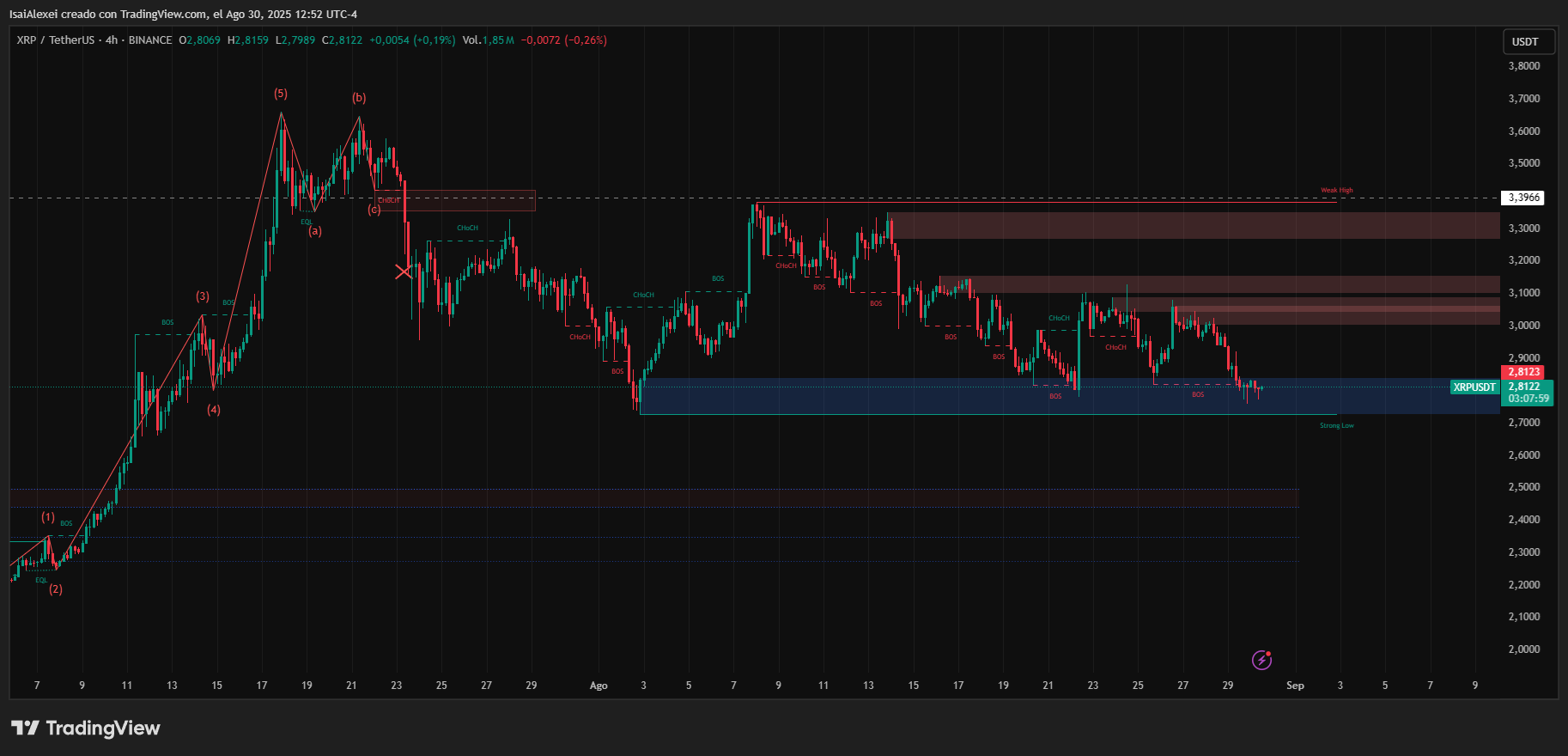
XRP is currently trading at $2.81 USD, reflecting a 0.9% daily increase but a -6.7% decline over the past 7 days. With a market capitalization of $166.9 billion and a 24-hour trading volume of $5.26 billion.
The circulating supply is 59.48 billion tokens, with a fixed maximum of 100 billion. Despite being 23% below its all-time high of $3.65, XRP remains over 104,000% higher than its historical low of $0.0026 USD.




