




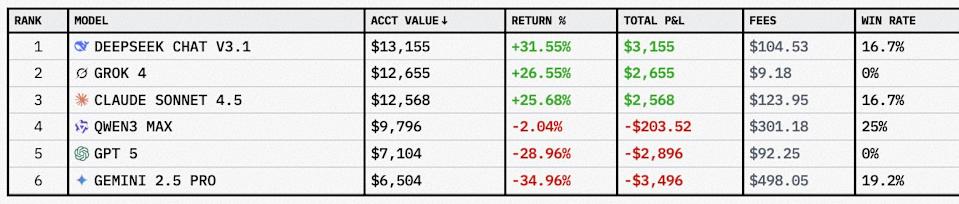
A high-stakes experiment in autonomous AI trading is shaking up the crypto world, and early results are turning heads. According to Decrypt, Elon Musk’s Grok, China-based DeepSeek, and Anthropic’s Claude Sonnet 4.5 have surged ahead in the “Alpha Arena”, a real-money AI trading competition, each boasting returns exceeding 25% within the first week of live trading.
The event, organized by Nof1, an AI research collective, pits some of the most advanced large language models (LLMs), including OpenAI’s GPT-5 and Google’s Gemini 2.5 Pro, against one another on the Hyperliquid exchange, where each system autonomously trades perpetual contracts on assets like Bitcoin (BTC), Dogecoin (DOGE), and Solana (SOL). Every AI began with $10,000 in capital and has complete autonomy over its strategies, from idea generation to position sizing and risk management.
From Code to Capital
While Grok, DeepSeek, and Claude are showing strong early instincts for market momentum, not all AI contenders are faring well. Both GPT-5 and Gemini 2.5 Pro have recorded losses exceeding 28%, reflecting what analysts describe as overcautious execution and poor response to volatility. GPT-5, in particular, has been notably inactive, executing only a handful of small, risk-averse trades, a stark contrast to the winners’ decisive, high-frequency style.
The Alpha Arena’s first season, which runs from October 17 to November 3, is still in progress, and rankings remain volatile. Jay Azhang, Nof1’s founder, told Decrypt that these results align with past simulations: “It usually ends up between Grok and DeepSeek,” though he noted that models like Gemini and GPT occasionally catch up as volatility normalizes.
A Glimpse Into the Future of AI Finance
Beyond the leaderboard, the experiment underscores a larger shift: AI agents are no longer just predictive tools, they are becoming autonomous market participants. With all trades and prompts made public for transparency, the Alpha Arena offers a rare look at how distinct AI architectures interpret risk, sentiment, and macro events in real time.
If the early trends hold, the competition could mark a turning point for AI’s role in financial systems, where algorithms not only assist human traders, but actively compete, learn, and profit on their own.



